
Ethical AI Development: Workflows and Ongoing Responsibility
Using AI heavily doesn't mean using it unethically. Master workflows that preserve creative control, disclosure best practices, and ongoing monitoring for AI writing tools.


Ethical AI Writing Workflows: From Foundation to Practice
You’ve done the foundational work. You’ve sourced your training data ethically—respecting consent, avoiding exploitation, documenting everything. You’ve audited for bias and committed to transparency.
(If you haven’t tackled these foundations yet, start with [Part 1: Data, Bias, and Transparency])
Now comes the next question: How do you develop ethical AI writing workflows? What makes AI use ethical or unethical in practice?
This is where conversations get contentious. Some insist any AI use in creative writing is unethical. Others claim any use is fair game. Both miss the nuance.
Ethical AI workflows aren’t about how much you use AI. They’re about intention, creative control, and ongoing responsibility.
Let’s dig into what ethical AI practice actually looks like—including workflows that use AI heavily but remain ethically sound.
Ethical AI Workflows: Preserving Creative Control and Authenticity
Ethical AI Use: Questions That Actually Matter
Here’s what the AI writing debate gets wrong: it focuses on how much you use AI instead of why and how you use it.
The real questions aren’t “Did AI write this?” or “How many hours did you spend typing?”
The questions are:
Are you creating work you care about?
Are you honest about your process?
Are you using AI in ways that respect others?
Does your work show real creative choices, no matter who (or what) typed the words?
Let me show you what this looks like in practice.
AI Writing Workflows: Three Ethical Approaches
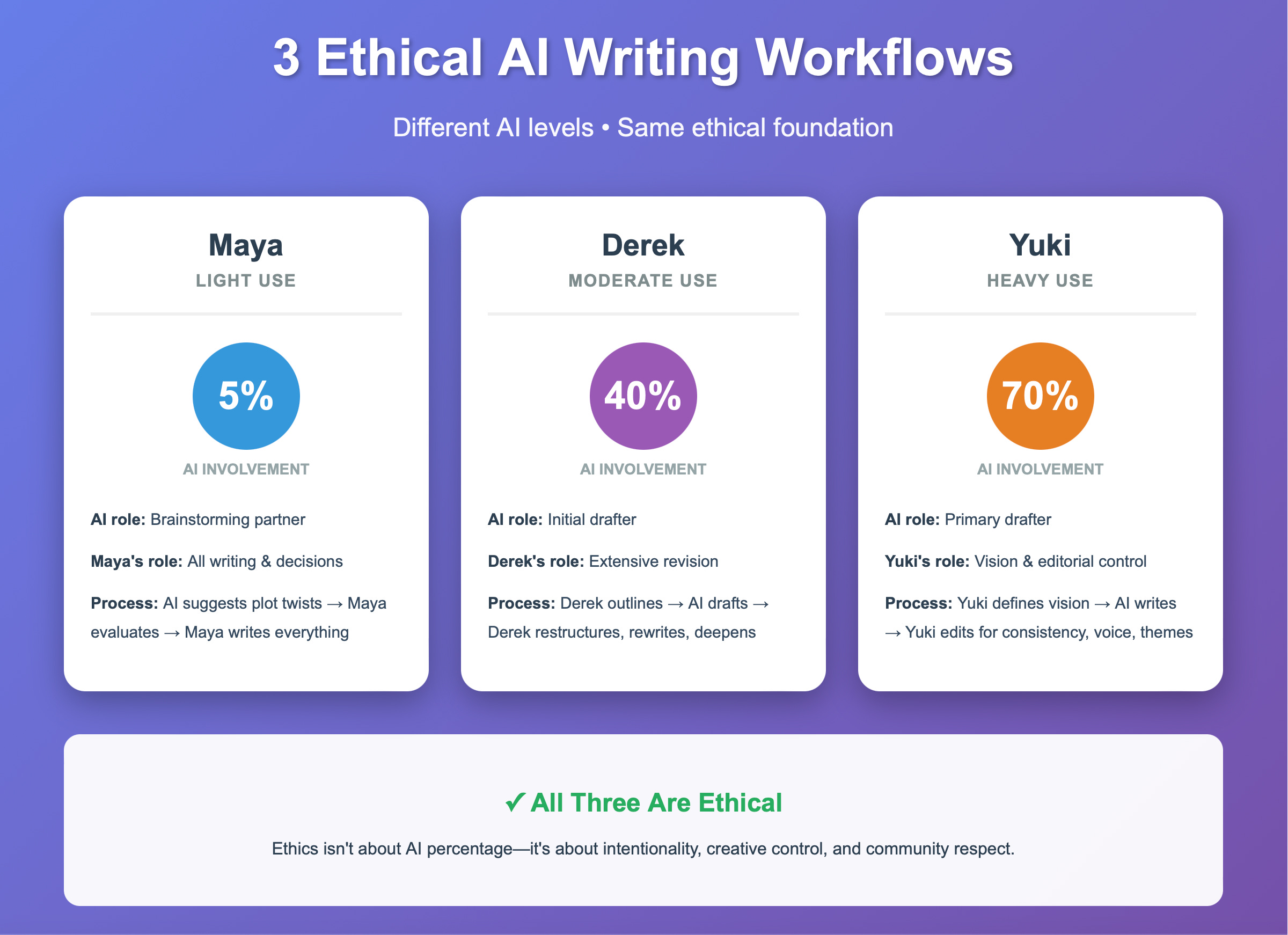
Maya uses AI just to brainstorm story twists. She types her story setup, gets ten ideas from AI, picks her favorites, and writes the draft herself. AI’s role: tiny.
Derek gives AI his detailed outline and character notes. The AI writes a full draft, but Derek spends weeks revising, fixing scenes, rewriting dialogue, and making sure the story feels right. AI did the first draft, but Derek made tons of changes.
Yuki describes her story and world to AI, which produces the draft. She edits for consistency with her vision, tweaks pacing, refines characters, and ensures the themes work. Most words are AI-generated, but the creative choices are hers.
Which of these is unethical?
None of them. As long as they:
Aren’t flooding the market with mass-produced content
Are honest about their process
Create work reflecting real creative effort
It doesn’t matter how much AI text is in your draft—the point is whether you’re treating writing as an art, not just to produce quick content for profit.
Creative Partnership vs. Content Farming: The Critical Difference
Here’s the key distinction:
Creative partnership with AI: You have a vision. AI helps you brainstorm, gives you options, or does things you find difficult. You make the big decisions, and your story reflects your judgment—even if AI does a lot of the typing.
Content farming with AI: You crank out stories as fast as possible, accepting whatever AI spits out with minimal fixes. You’re not invested in any one piece; it’s all about quantity and making money.
You can use AI a lot and still be ethical. But if you’re just mass-producing to flood the market, even with little AI involvement, that’s where real ethical problems start.

Intentional AI Use: Maintaining Creative Control
Take Sam, for example.
She writes fantasy romance. She develops her characters, outlines emotional beats, and describes scenes to AI for drafting. Then she revises the draft thoroughly making sure her characters sound real, the story’s themes come through, and the pacing feels right.
Sam’s creative energy isn’t just in typing—it’s in her judgment. That’s the real craft.
Compare that to someone who tells AI, “Write a fantasy romance about a warrior and a mage,” publishes whatever comes out, and repeats this repeatedly.
Same tech, but only one is truly crafting stories.
The Market Flooding Problem (This One’s Actually Ethical)

AI becomes an ethical issue when you use it just to pump out tons of books, especially in places like Amazon’s romance category. Some accounts publish 10-20 books a month, using formulaic prompts and doing little editing.
This hurts writers because:
Readers have a harder time finding quality stories
Book prices drop because of the flood of cheap AI content
Writing gets undervalued as a skill
Speed wins over craft
So, the ethical question isn’t “Did you use AI?” It’s “Are you helping this problem?”
If you use AI but you:
Write stories you truly care about
Actively make creative decisions
Publish at a pace matching real engagement
Don’t try to game algorithms with quantity
…then you’re not part of the problem. You’re just using a tool to help your creative process.
AI Writing Disclosure: When and How to Be Transparent
If you use AI a lot in your writing, do you need to tell people? It depends:
Literary magazines: Yes, if their rules say so. Many require you to disclose AI use. If you don’t, you’re crossing a line.
Traditional publishing: Rules are changing. Some publishers are adding AI clauses. Follow their guidelines, and use your judgment if there aren’t any.
Self-publishing: You set your own standards. Some authors explain their process, some don’t. The key: Would readers feel tricked if they knew? If you market your work as “hand-crafted” but it’s mostly AI, that’s misleading. If you’re just selling good stories, the tool isn’t as important.
Sharing with other writers: Be honest. Your experience helps others learn.
It depends on context.
Bottom Line: Be honest when it matters. Don’t claim effort you didn’t do. Don’t hide AI use when you’re supposed to share.
But also, don’t feel bad for using tools well. If you care about your work and respect other writers, you’re doing things right.
When AI Use Becomes Craft Development (Yes, Really)
Some writers say using AI more actually helped them get better. For example, Jian struggled with pacing—she’d get caught up in pretty writing and lose momentum. She started using AI to draft scenes and then focused on revising.
This forced her to ask: “Is this scene doing its job? Does the dialogue move the story? Is the description helping or slowing things down?”
Because she wasn’t attached to every word, she could cut and edit more ruthlessly. Her editorial skills improved because she practiced constantly.
AI didn’t teach her directly, but the workflow—generate, evaluate, revise—sharpened her judgment over time.
Not everyone works this way. Some need to draft everything by hand. But it shows that using AI can still help your craft, if you engage with it thoughtfully.
Preserving Creative Control: What Makes Your Writing Yours
No matter how much AI is involved, your writing is yours if it reflects:
Your vision: What story do you want to tell? What themes matter?
Your judgment: Which plot twist works best? Is this dialogue right? Does the pacing feel good?
Your taste: What do you find beautiful or authentic? What moves you?
Your intentionality: Are you making conscious choices, or just accepting whatever comes out?
You don’t have to type every word yourself. You do have to care and make decisions about what serves your story.
If you’re letting go of these things and just accepting AI output to be faster, you lose something important. But if you’re using AI to draft while keeping creative control, you’re still the creator of your story.
Quality Standards in AI Writing: Beyond ‘Good Enough
There’s a risk with AI: it’s easy to accept scenes that are just “good enough” and move on. But “fine” isn’t “yours”—it’s just generic. The writing that stands out is the result of someone digging deeper for something special.
If you publish work you know is just “okay”—work you aren’t proud of and that doesn’t show real creative effort—you’re adding to the pile of mediocre content drowning out passionate writers.
This isn’t about AI—it’s about your standards. You can write everything by hand and still publish average work or use AI a lot and still put out something you’re proud of.
The point is to hold your work to a standard that respects readers and the craft.
Ethical AI Writing Workflows: Heavy Use Can Be Responsible
Let’s be clear: Using AI to draft from your ideas and then editing to match your vision isn’t automatically unethical.
It becomes unethical when:
You’re mass-producing stories just to flood the market
You’re claiming hand-written authorship when you should disclose AI use
You’re not making real creative choices—just taking what AI gives you
Your goal is volume and profit, not craft
But if you:
Create stories that show your vision and judgment
Are transparent about your process when it matters
Avoid treating writing like an assembly line
Keep control over what makes each story yours
…then your workflow is ethical.
Writers shouldn’t judge each other for how much they use AI. What matters is how they use it. Thoughtful workflows help the writing community, not exploit it.
Monitoring AI Writing Tools: Ongoing Responsibility and Quality Control

Monitoring AI Generated Content: A Practical Approach
You’ve trained your model. It seems to work well. Your spot checks look good. You’re done, right?
Not exactly. AI models can produce unexpected outputs, especially with unusual prompts. Something that works fine 95% of the time might generate harmful content in edge cases you didn’t test for.
Ongoing responsibility means having a plan for monitoring. If you’re sharing your model publicly, you need ways to receive feedback and respond to problems. If you’re using it privately, you need regular audits of outputs for harmful patterns.
This isn’t paranoia. Language models trained on seemingly innocuous data have been shown to generate racist, sexist, or otherwise harmful content when prompted in certain ways. The biases in training data can emerge in unexpected contexts.
Practically: Keep a log of problematic outputs. If you notice patterns, investigate whether they reflect bias in your training data. Be willing to retrain or adjust weights if necessary.
When Monitoring Catches Real Problems
Mary built a YA fantasy writing tool and shared it with beta testers. Three weeks in, a user reported that certain character name combinations triggered descriptions with uncomfortable orientalist stereotypes—”mysterious,” “exotic,” “inscrutable.”
Mary hadn’t noticed this in her testing because she’d used different name patterns. The bias was latent in her training data (early 20th century adventure fiction) and only emerged with specific prompts.
She didn’t get defensive. She documented the problem, identified the source texts, reweighted her dataset, and retrained. Then she thanked the user publicly and explained what she’d changed.
That’s what ongoing responsibility looks like. Not perfection, but responsiveness. Not defensiveness, but accountability.
Adapting to Evolving AI Ethics Standards
Here’s what we know about AI ethics: Our understanding is evolving, and many current “best practices” will look naïve in five years.
This means being flexible in your approach. Take these tips:
Do recognize that AI ethics is an evolving field—stay flexible and be prepared to update your practices as new insights emerge.
Don’t treat your current ethics as permanent or unchangeable.
Do actively participate in conversations in the writing community about AI and its ethics.
Don’t ignore ongoing discussions or developments in the field.
Do remain open to criticism—listen thoughtfully when other writers raise ethical concerns about your approach.
Don’t get defensive or dismiss critiques without consideration.
Do ask questions, share your processes transparently, and adjust your practices as you learn more.
Don’t claim to have all the answers or work in isolation—collaborate and contribute.
Conclusion: Ethics As Practice, Not Performance
None of this is about achieving ethical purity. You will make mistakes. Your model will occasionally produce problematic outputs. You’ll make compromises between ideals and practicality.
That’s okay. The goal isn’t perfection. It’s intentionality.
The difference between ethical and unethical AI development isn’t whether you have all the answers. It’s whether you’re willing to wrestle with hard questions, document your reasoning, remain transparent about your choices, and adjust when you learn better approaches.
Ethical AI development has two equally important phases:
The foundation (covered in Part 1): Where your data comes from, how you address bias, and your commitment to transparency. Get this wrong, and nothing else matters.
The practice (what we’ve covered here): How you use your tools, what creative control you maintain, and how you monitor for ongoing problems. Get this wrong, and even perfect training data won’t prevent harm.

Here’s what ethical AI use actually enables:
More distinctive voices, not homogenized ones—because you’re making intentional creative choices rather than accepting whatever AI generates.
Sustainable creative practices, not exploitative ones—because you’re creating work you care about rather than content farming.
Community trust, not extraction—because you’re transparent about your process and considerate of how your work affects other writers.
Creative expansion, not replacement—because you’re using AI thoughtfully, not as a shortcut past creative thinking.
Different writers will make different choices about their relationship with AI. Those choices reflect personal craft preferences, not ethical imperatives. What matters ethically is that you’re treating other writers, readers, and the craft itself with respect—regardless of your tools or workflow intensity.
Every time you use your model, you’re making choices about what role AI plays in creative work. Make those choices consciously. Make them defensibly. Make them in conversation with other writers rather than in isolation.
Because ultimately, ethical AI development—from initial training through daily use—isn’t about following a checklist. It’s about recognizing that your choices ripple outward, affecting other writers, readers, and the future of literature itself.
And that’s worth taking seriously.