
The False Binary: Why 'Generative AI vs. Assistive AI' Misunderstands How Technology Actually Works
Spell check, Grammarly, and ChatGPT all use generative AI. The distinction between 'assistive' and 'generative' AI is marketing, not technology. Here's why the binary collapses.


“Hey, so... if you’re an author/writer and you brag about how AI is helpful for feedback on writing... It’s an instant block.
Now, I’m not talking spell check or anything like that. That is Assistive AI and it is something we have used for a long time.
GenAI steals from the creative minds of the world. If you use GenAI (like ChatGPT) to write, you are stealing from your peers.
You are also stealing jobs from other creatives like editors. FEEDBACK IS THEIR WHOLE JOB. When we say no AI we mean GenAI, not assistive AI.
If people want to argue they need to learn the difference first😒
—A Commenter on Author Threads
Table of Contents
Assistive vs Generative AI: Understanding the Terminology
This comment captures a growing debate on social media: the insistence on a clear line between “Assistive AI” (good) and “Generative AI” (bad).
The claim: There is a moral and practical distinction between tools that merely assist (like spell check) and those that generate (like ChatGPT).
The examples given: Spell check is framed as assistive and therefore acceptable, while using ChatGPT for feedback is labeled generative and therefore theft.
The conclusion: Anyone who disagrees is told they “need to learn the difference first.”
The neat division between “generative” and “assistive” AI doesn’t hold up. Most modern tools labeled “assistive” — grammer checkers, predictive text, even advanced spell check — are powered by generative models.
Writers with disabilities, learning differences, or language barriers find AI beneficial. Critics dismissing these tools as “generative theft,” exclude entire communities from creative participation.
These arguments are purity tests — rigid standards of “acceptable” creativity. They don’t protect creative labor; they narrow it, stigmatize it, and ignore the messy reality of how technology evolves.
Note: For simplicity sake, I’ll often say ChatGPT, but the information here can apply to all LLMS (Claude, Gemini, etc.)
The Technical Reality: There is No Hard Line
What Is Generative AI?
Definition: Generative AI refers to systems that create new content—images, text, video, or sound—based on patterns learned from training data.
Generative AI systems rely on deep neural networks, especially large language models (LLMs) built on the transformer architecture, which uses self‑attention mechanisms to process and generate sequences.
The underlying function doesn’t distinguish between “assisting” and “generating”. Whatever it’s doing, the models follow the same predictive process.
Common ‘Assistive’ AI Tools That Are Actually Generative
Spell Check and Grammar Tools
What people think they do: Simple dictionary lookups or rule-based grammar checks.
How they really work:
Grammarly uses neural networks and machine learning models
ProWritingAid uses AI to suggest style improvements, tone adjustments, sentence restructuring
These tools generate alternative phrasings—that’s generative AI
They predict what you “meant” to say based on patterns from millions of texts
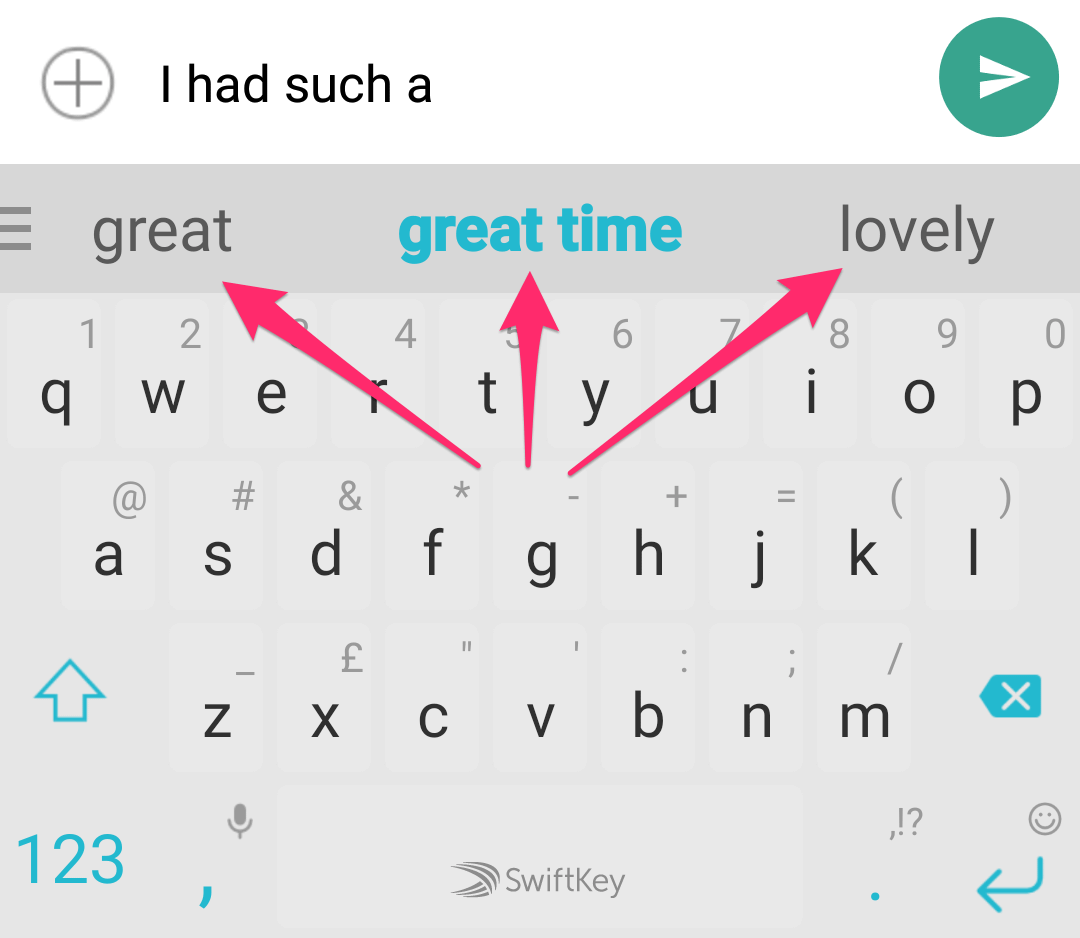
Grammarly, Google Translate, and QuillBot: Generative AI in Disguise
Grammarly: Launched in 209 as a grammar checker, it now includes generative AI features (launched in 2023) that can rewrite sentences, adjust tone, and even draft new text
Google Translate: Introduced its neural machine translation system in 2016, which generates fluent sentences rather than word‑by‑word substitutions. They allow multilingual writers to draft, edit, and communicate across languages.
QuillBot: Founded in 2017 and popular among students and professionals for paraphrasing and summarizing, it generates alternative versions of text rather than just flagging errors.
ChatGPT vs Grammarly for Writing Feedback: What’s the Difference?
The Claim: Using ChatGPT for feedback is theft from editors.
Let’s examine this step by step.
What editorial feedback looks like:
Developmental editing: “This character’s motivation is unclear,” “This plot thread goes nowhere,” “Your pacing drags in the middle”
Line editing: “This sentence is awkward,” “This word repeats too often,” “This metaphor is mixed”
Copy editing: Grammar, spelling, punctuation
Can AI do this? Yes. ChatGPT can analyze narrative flow and highlight unclear motivations or pacing issues. Grammarly markets itself as providing tone and clarity feedback. Both use the same underlying technology—neural networks generating suggestions based on learned patterns.
The Question: If Grammarly Premium offering feedback is considered “assistive,” but ChatGPT offering feedback is condemned as “stealing editors’ jobs,” what’s the actual difference?
The Answer: Branding and public perception, not functionality. Both tools perform generative tasks: they analyze text, predict improvements, and generate alternative phrasing or structural suggestions. The distinction is rhetorical, not technical.
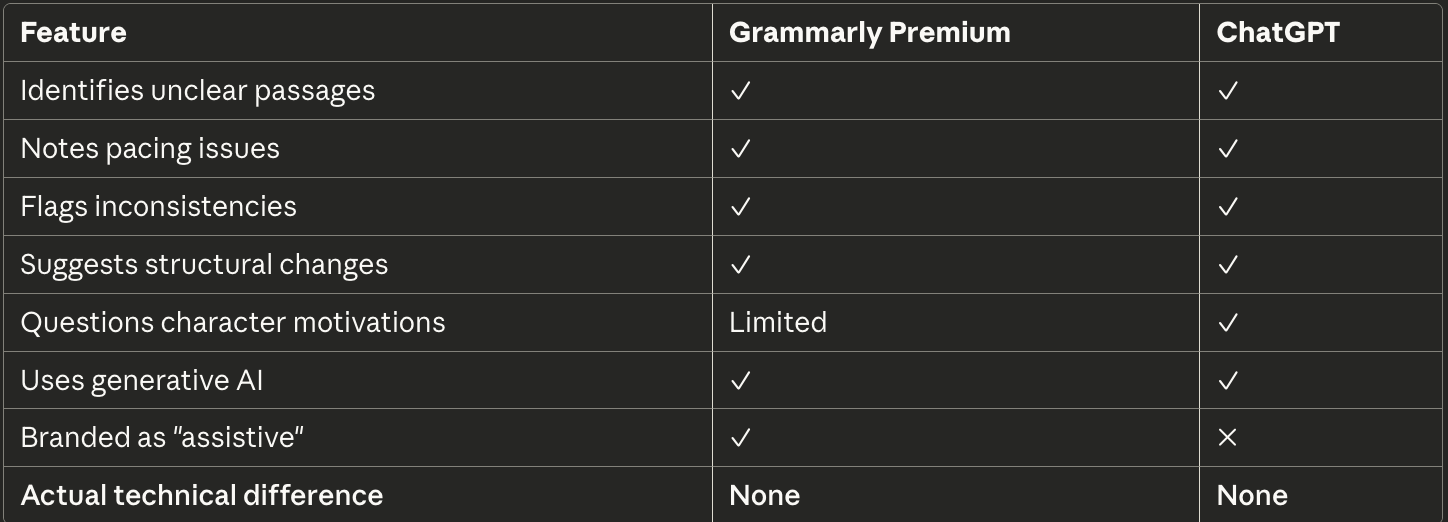
The Inconsistency: Where Do We Draw Lines?
The Technology Has Evolved
1990s spell check: Basic dictionary lookup. It flagged misspelled words by comparing them against a static word list.
2020s spell check: Generative AI suggesting rewrites, tone adjustments, and clarity improvements. Grammarly Premium, Microsoft Copilot, and Google Docs now generate alternative phrasing, not just error flags.
Both are called “spell check,” but one is definitionally generative AI. The name stayed the same, but the underlying technology changed.
The Slippery Slope Is Real
If AI-generated suggestions are “theft,” then spell check is theft.
If spell check is okay because it’s “just fixing errors,” then AI feedback is okay because it’s “just offering suggestions.”
The inconsistency reveals that the line isn’t technical—it’s rhetorical. What counts as “assistive” or “generative” depends on branding and perception, not on what the technology actually does.
If you use Grammarly, you use GenAI. If you use autocomplete, you use GenAI. The difference between you and the person you’re condemning is just which interface you prefer.
Testing the Framework with Real Scenarios
Scenario 1: The Dyslexic Writer
Uses Grammarly to restructure sentences for clarity
Question: Is Grammarly generating new sentences? Yes.
Question: Is this acceptable? Most would say yes.
Now: Same writer asks ChatGPT “Can you suggest a clearer way to phrase this paragraph?”
Question: Is ChatGPT generating new sentences? Yes.
Question: Is this acceptable? The comment says no.
What changed? Nothing technical. Only the interface and branding.
👉 Grammarly explicitly markets itself as providing real-time feedback and clarity improvements using generative AI.
Scenario 2: The ESL Author
English is their third language
Uses ProWritingAid to check if their idioms sound natural
Question: Is ProWritingAid using its training data (other people’s writing) to make suggestions? Yes.
Question: Is this “stealing from creative minds”? (By the comment’s logic) Yes.
Question: Would we actually tell this author to stop? Hopefully not.
👉 ProWritingAid openly acknowledges that it uses AI to analyze documents, suggest rewrites, and improve readability and tone.
Key Point
Across these scenarios, the supposed line between “assistive” and “generative” breaks down. The same tasks—clarity checks, idiom suggestions, structural analysis—are accepted when branded as “assistive,” but condemned when branded as “generative.”
📊 By the Numbers:
- Professional editing costs: $2,000-$5,000 per book
- Grammarly users: 30+ million (most unaware it’s generative AI)
- Writers who can’t afford editors: Majority of unpublished authors
The “Theft” Question
The comment’s claim: “GenAI steals from the creative minds of the world.”
How Spell Check, Grammarly, and ChatGPT Learn
Spell check: Early versions relied on dictionary lookups; modern versions use machine learning to predict corrections.
Grammarly: Trains its models on user text data (with opt‑out options) to improve clarity and tone suggestions.
ChatGPT: Trained on large datasets, including publicly available text, to generate new responses.
So where’s the line where training becomes “theft”?
All Learning Involves Patterns from Others
Authors learn by reading other authors: Every writer absorbs style, vocabulary, and narrative techniques from prior works.
Writing workshops analyze published works: Students dissect novels, essays, and poems to understand craft.
MFA programs deconstruct techniques: Formal education explicitly teaches pattern recognition from existing creative works.
AI pattern‑recognition is not fundamentally different — it’s an automated version of what humans do when they internalize patterns.
The Legal Reality
Copyright law basics: You cannot copyright style, ideas, or facts; only specific expression is protected.
AI outputs: Generative systems don’t copy‑paste (except in rare edge cases). They generate new text based on statistical patterns in training data.
Human analogy: A novelist who has read widely is also generating new text based on learned patterns. Functionally, the process is similar.
Key Point
The “theft” framing collapses because:
All AI tools, even “assistive” ones, are trained on text data.
Human creativity also relies on learning from others.
Legally, copyright protects expression, not style or influence.
The difference is one of degree and scale, not of kind. Branding and perception, not technical reality, drive the claim that generative AI is theft.
Creative Writing: Where the Contradictions Are Sharpest
The Tools Writers Already Use (That Are Actually GenAI)
Character Name, Plot, and Title Generators
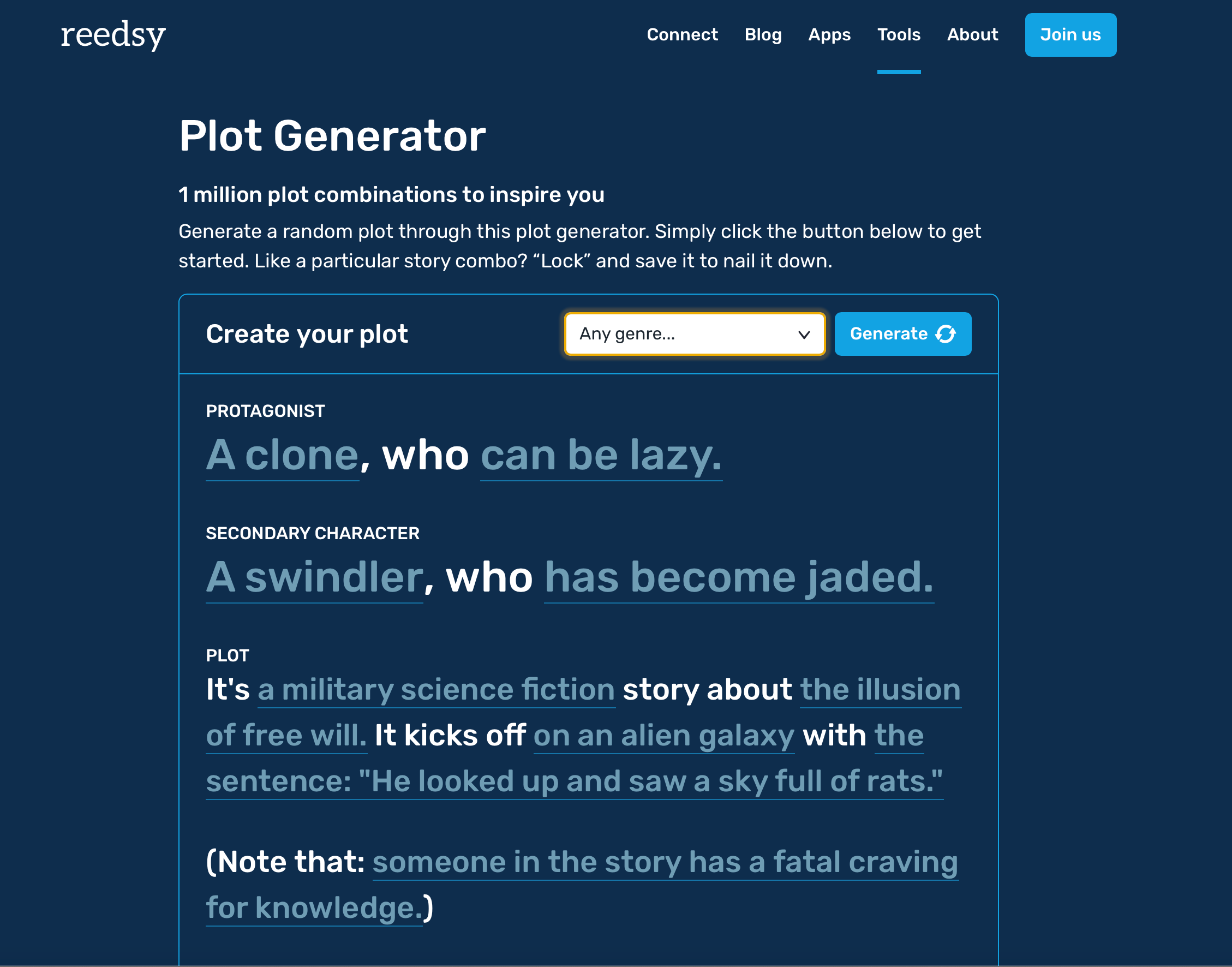
Many tools on the internet (Reedsy’s Character Name Generator) use AI to suggest names, plots and book titles.
Question: Is this theft from other authors who created those names or plots? Most would say no — names are generated patterns, not copied expressions. Additionally, plot archetypes have always been shared across literature, from Shakespeare to Hollywood screenwriting.
Reedsy’s suite of writing generators (like character name, plot, and prompt tools) have been available since around 2016, when the company launched its free online Book Editor.
Thesaurus and Word Choice Tools
Modern thesauruses like Power Thesaurus use machine learning to suggest contextually appropriate alternatives.
Question: Is this different from ChatGPT suggesting a better word? Functionally, no — both generate alternatives based on learned patterns.
Scrivener’s Auto‑Complete
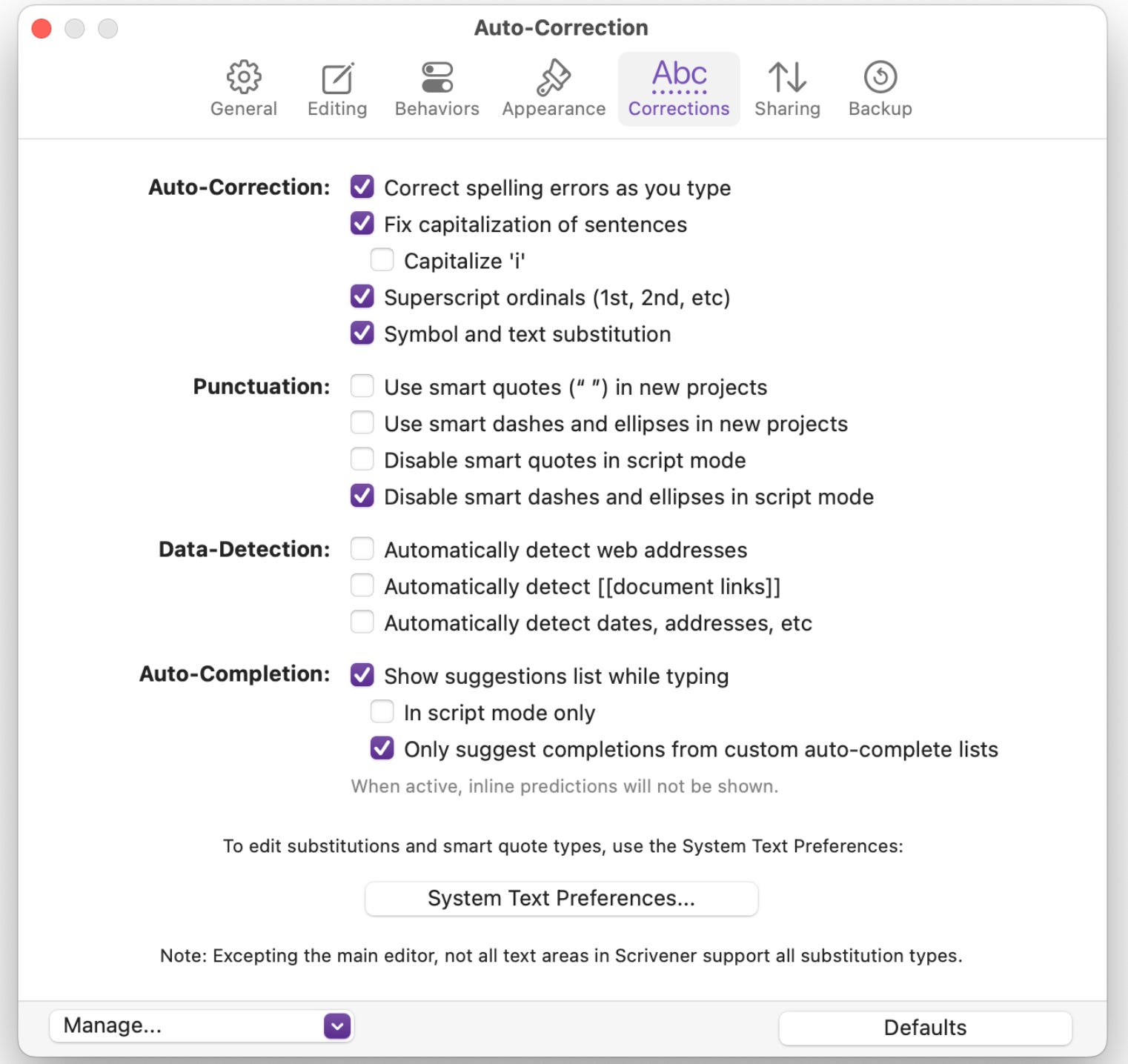
Scrivener’s auto‑complete feature learns from your writing and suggests completions, much like predictive text on smartphones (Literature & Latte Blog).
Question: This is literally predictive text generation. Why is it considered “assistive” rather than “generative”?
Key Point
These examples show that writers already use generative AI daily — whether for names, plots, word choice, predictive text, or readability.
AI Accessibility: How Disabled Writers Use Generative AI Tools
Writers with disabilities already use AI—whether managing ADHD-related continuity issues (ChatGPT can summarize chapters and track plot threads), conserving limited energy with chronic fatigue (AI scans drafts for continuity errors), or using voice-to-text for dysgraphia (dictation plus AI restructuring transforms spoken fragments into coherent drafts). The technology is identical; only the framing changes.
Studies on accessibility note that AI tools expand opportunities for disabled and marginalized creators, reducing barriers to collaboration.
Calling one use “assistive” and the other “theft” ignores that the same technology serves different needs.
The Real Question: What Are We Protecting?
The “Stealing Jobs” Argument
The comment’s claim: Using ChatGPT for feedback steals from editors.
Reality Check: Who Hires Editors?
Traditionally published authors: Publishers pay for editing as part of the production process. Authors don’t hire editors directly.
Self‑published authors: Must pay out‑of‑pocket, often $2,000–$5,000 per book for professional editing services. (That includes developmental, copy editing, and proofreading)
Unpublished authors: Frequently cannot afford professional editing at all, meaning they go without feedback.
The Cost of Professional Editing vs AI Feedback
Most writers using ChatGPT for feedback cannot afford human editors. They are not replacing a service they were buying; they are accessing feedback they otherwise wouldn’t have. For many, AI feedback is the difference between having any editorial input and having none.
What This Means for Disabled and Marginalized Writers
If you can’t afford an editor and you’re told you can’t use AI, you don’t get feedback. Writers with disabilities, chronic illness, or limited resources are disproportionately excluded when AI is framed as “theft.”
Key Point: The “stealing jobs” argument collapses under economic and historical scrutiny. For most writers, AI feedback isn’t replacing editors—it’s providing access to feedback they never had.

The “Stolen Work” Debate
A common refrain goes: “[Insert accepted writing tool here] wasn’t trained on stolen work. ChatGPT was, therefore it’s unethical and not allowed!”
The Problems with This Claim
All AI tools are trained on text data. Training ≠ copying. Human learning works the same way.
Spell Check
Early spell checkers (1990s): Early spell checkers (1990s) were trained on dictionary databases and large text corpora like the British National Corpus, which compiled ‘a wide range of sources including books, newspapers, journals, letters, and speech’ (BNC Documentation) without individual author consent.
Consent status: No individual authors were asked for permission—the same methodology upheld as fair use in Authors Guild v. Google (2015), where the Second Circuit ruled that using copyrighted text for analysis constitutes transformative use.”
Grammarly
Training data: Grammarly uses user text data to improve its models, unless users opt out.
Consent status: Original training relied on large text corpora and user submissions. Only recently has Grammarly added an opt‑out toggle for users who don’t want their writing used for AI training.
ProWritingAid
Training data: Like Grammarly, ProWritingAid uses large text datasets and user input to refine its models.
Consent status: No evidence of original author consent for the corpora used; the system is built on aggregated text patterns.
Broader Context
Assistive vs. generative tools: Both rely on training data from human writing. The difference is branding, not methodology.
Legal reality: Current copyright law does not require consent for training on style, ideas, or facts (U.S. Copyright Office Compendium § 313.4).
Recent shift: The debate over consent has sharpened with generative AI (like ChatGPT), but the underlying practice of training on text without individual permission has been standard for decades.
Key Point
The claim that “ChatGPT is unethical because it was trained on stolen work” ignores the fact that spell check, Grammarly, ProWritingAid, and other accepted tools were also trained on text without original consent. The difference is perception: one is branded “assistive,” the other “generative.”
A Better Framework
4 Questions That Matter More Than ‘Is It GenAI?
The “assistive vs. generative” distinction collapses under scrutiny. Instead of clinging to that binary, a more useful framework asks practical, ethical questions about how AI is used.
1. Is the creator making meaningful decisions?
Typing a prompt and using the output verbatim: Minimal creativity. The human is not shaping or refining the work.
Using AI for feedback, iteration, and refinement: Significant creativity. The writer remains in control, making choices about what to keep, discard, or revise.
Using AI as one tool among many: Standard creative process. Writers already combine dictionaries, thesauruses, workshops, and templates with their own judgment.
👉 Research on human–AI collaboration shows that creativity is maximized when humans remain the decision‑makers, using AI as a tool rather than a replacement.
2. Is the creator transparent?
Hiding AI use while claiming “all human”: Deceptive. Misrepresentation erodes trust.
Disclosing AI use when relevant: Honest. Transparency allows audiences to evaluate the process.
Not disclosing every tool ever used: Normal. We don’t list pencil brands or word processors in book acknowledgments.
👉 The U.S. Copyright Office emphasizes disclosure in registration of AI‑assisted works, requiring authors to identify AI contributions while affirming human creative control.
3. Is the use replacing human connection or enhancing it?
Using AI instead of ever seeking human feedback: Isolation. Risks cutting off valuable dialogue with editors, peers, and readers.
Using AI to refine work before showing it to humans: Preparation. Strengthens drafts and makes human feedback more productive.
Using AI when human feedback is inaccessible: Pragmatic. For writers without resources, AI provides a bridge to participation.
👉 Studies on accessibility note that AI tools expand opportunities for disabled and marginalized creators, reducing barriers to collaboration.
4. Is there informed consent in commercial contexts?
Selling AI‑generated art as “hand‑painted”: Fraud. Misrepresentation in commerce is unethical and often illegal.
Selling AI‑assisted work with disclosure: Transparent. Readers and buyers can make informed choices.
Using AI in personal creative process: No one’s business. Private drafting practices don’t require disclosure.
👉 Consumer protection law already treats misrepresentation as fraud, whether about materials, methods, or provenance.
Key Point
The better framework isn’t “assistive vs. generative.” It’s about agency, transparency, connection, and consent. These criteria protect both creators and audiences without collapsing into arbitrary binaries.
Questions That Matter
Instead of “Did you use GenAI?” ask:
For publishers/clients:
“Does this work meet our quality standards?”
“Is the creator able to revise and iterate?”
“Do they understand what they’ve made?”
For readers/audiences:
“Does this work speak to me?”
“Is it well-crafted?”
“Do I care how it was made?” (Often no)
For the creative community:
“How do we ensure fair compensation for all creators?”
“How do we make creative tools accessible?”
“How do we support human creativity in an AI age?”
(Not: “How do we punish people for using tools wrong?”)
Conclusion: The Category Is a Lie
Returning to the Comment
The comment’s core claim: “When we say no AI we mean GenAI, not assistive AI. If people want to argue they need to learn the difference first.”
The reality:
The difference is marketing, not technology.
Spell check is GenAI.
Grammarly is GenAI.
ChatGPT for feedback is GenAI.
They are all the same thing with different interfaces.
The implication:
“Learn the difference” actually means “accept my arbitrary line.”
The line is based on vibes, not understanding.
It collapses the moment you examine it.
What We’re Really Saying
When someone says “GenAI is theft, assistive AI is fine”:
What they often mean:
“The AI I use is fine, the AI you use is cheating.”
“My accommodations are legitimate, yours are excuses.”
“I’m uncomfortable with change and disguising it as ethics.”
What they’re actually doing:
Creating a purity test that they happen to pass.
Gatekeeping who gets to call themselves a creator.
Punishing people with less access to traditional resources.
The Path Forward
We can:
Acknowledge AI raises real ethical questions (training data, labor, environment).
Advocate for better practices and regulations.
Support human creativity and fair compensation.
Without:
Pretending there’s a clear line between “good” and “bad” AI.
Shaming disabled people for their tool choices.
Creating unenforceable purity standards.
Gatekeeping based on misunderstood technology.
The Uncomfortable Truth
If you use Grammarly, you use GenAI.
If you use autocomplete, you use GenAI.
If you use predictive text, you use GenAI.
The difference between you and the person you’re condemning is just which interface you prefer.
The Final Question
Do we want a creative world where access to tools determines who gets to participate? Or one where we judge work on its merits and support creators in using whatever helps them make good work?
Because right now, we’re building the former while claiming to protect the latter.
Thank you for resolving a fair bit of cognitive dissonance. Coming from a background in research where AI has been used ethically for a long time, I had trouble putting my finger on exactly why use of LLM’s in art or in the actual writing of scientific articles put such a bad taste in my mouth. The assistive vs generative AI seemed like a fruitful distinction at first I think because it hinted at the difference between ethical and unethical use. Ultimately, I was blaming the technology for its unethical usage…