
Tried by Algorithm: How a Mob Decided Mia Ballard Was Guilty Before Hachette Did
Hachette cancelled Mia Ballard's contract one day after the New York Times called. Here's why the process that determined her guilt was broken regardless of what she did

On March 19, 2026, the New York Times contacted Hachette Book Group with questions and evidence regarding Shy Girl, a horror novel by debut author Mia Ballard.
Roughly 24 hours later, Hachette announced it would cancel the US release and discontinue the UK edition, which had been on shelves since November 2025.
Twenty-four hours. That is how long Hachette’s thorough and lengthy review of the text took to produce a formal decision—once a major publication made the question unavoidable.
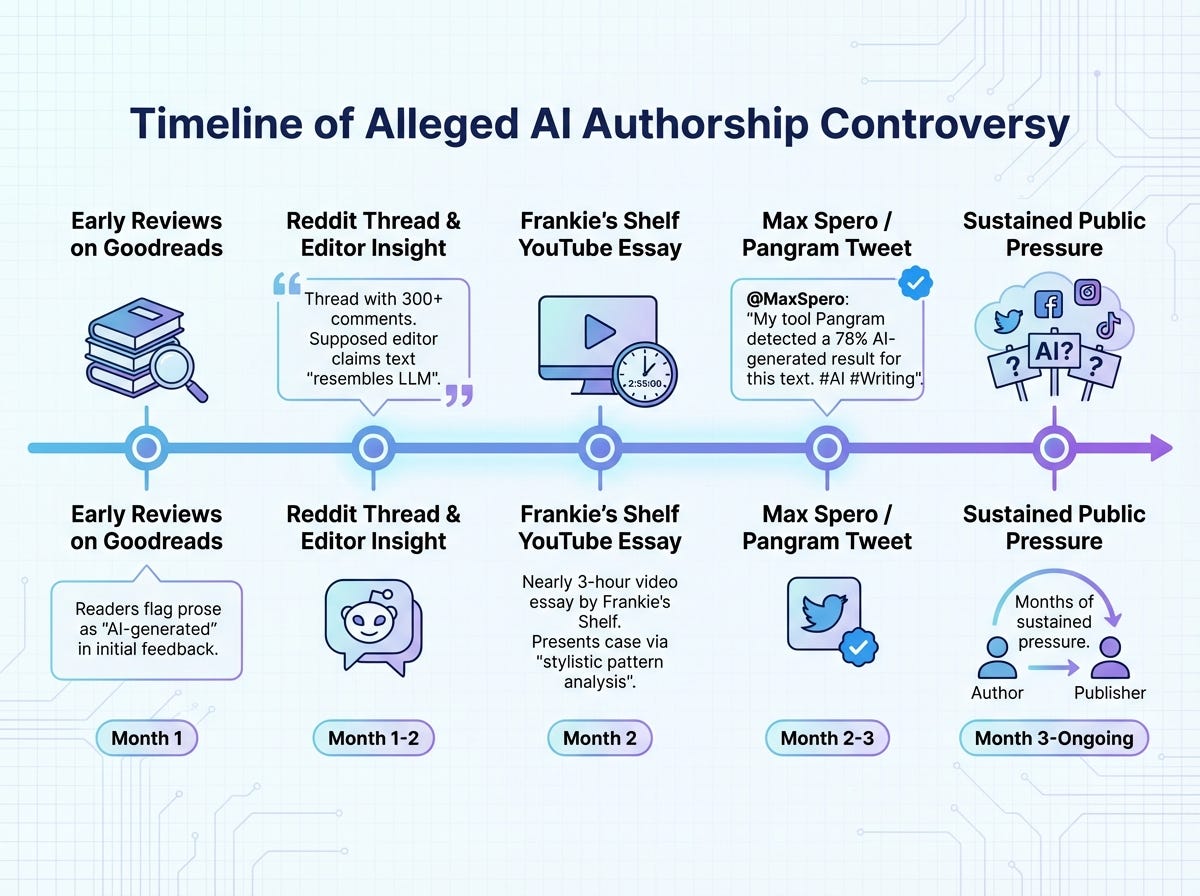
What had preceded that call, over the course of more than a year:
Readers on Goodreads flagged the prose as AI-generated in early reviews.
A Reddit thread generated over 300 comments, including one from a user identifying themselves as a book editor who described the text as bearing every hallmark of a large language model.
A nearly three-hour YouTube video essay by the channel Frankie’s Shelf, which accumulated over a million views and presented a case built on stylistic pattern analysis.
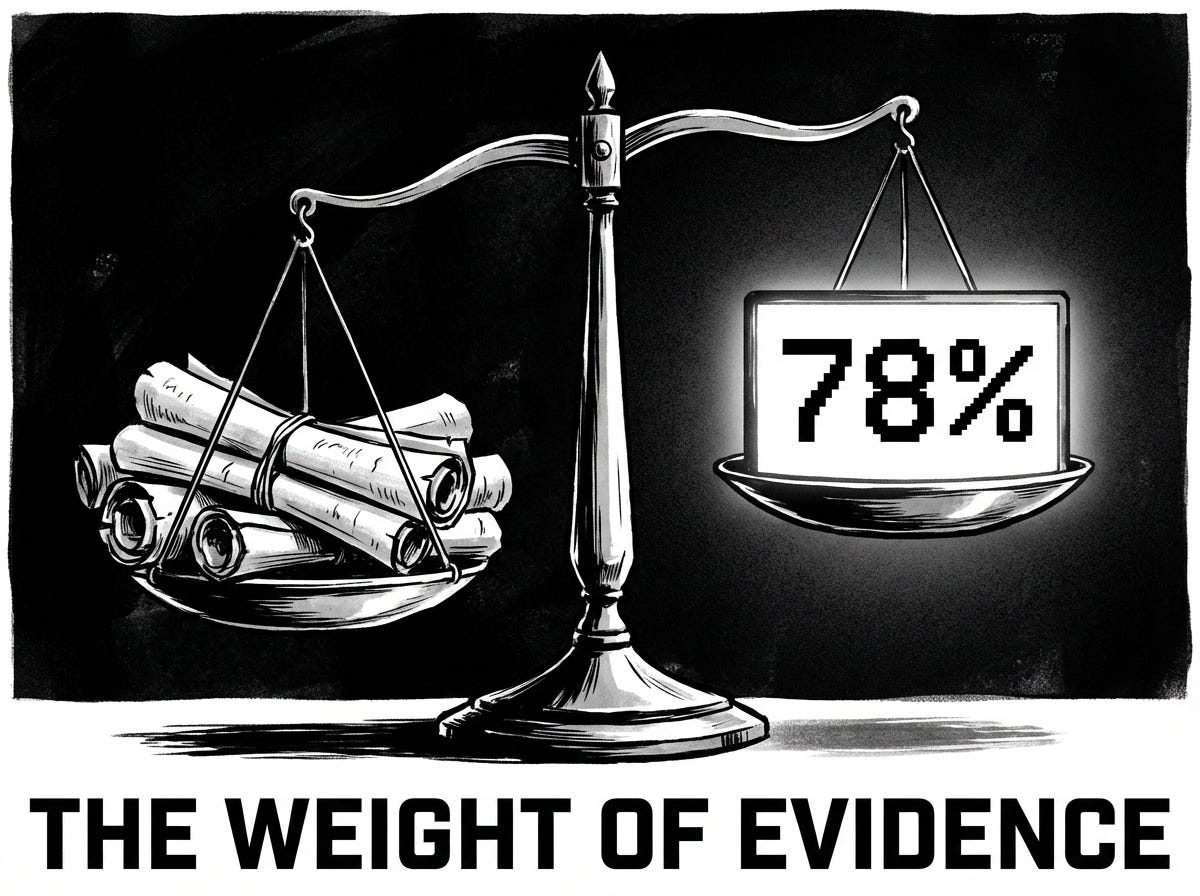
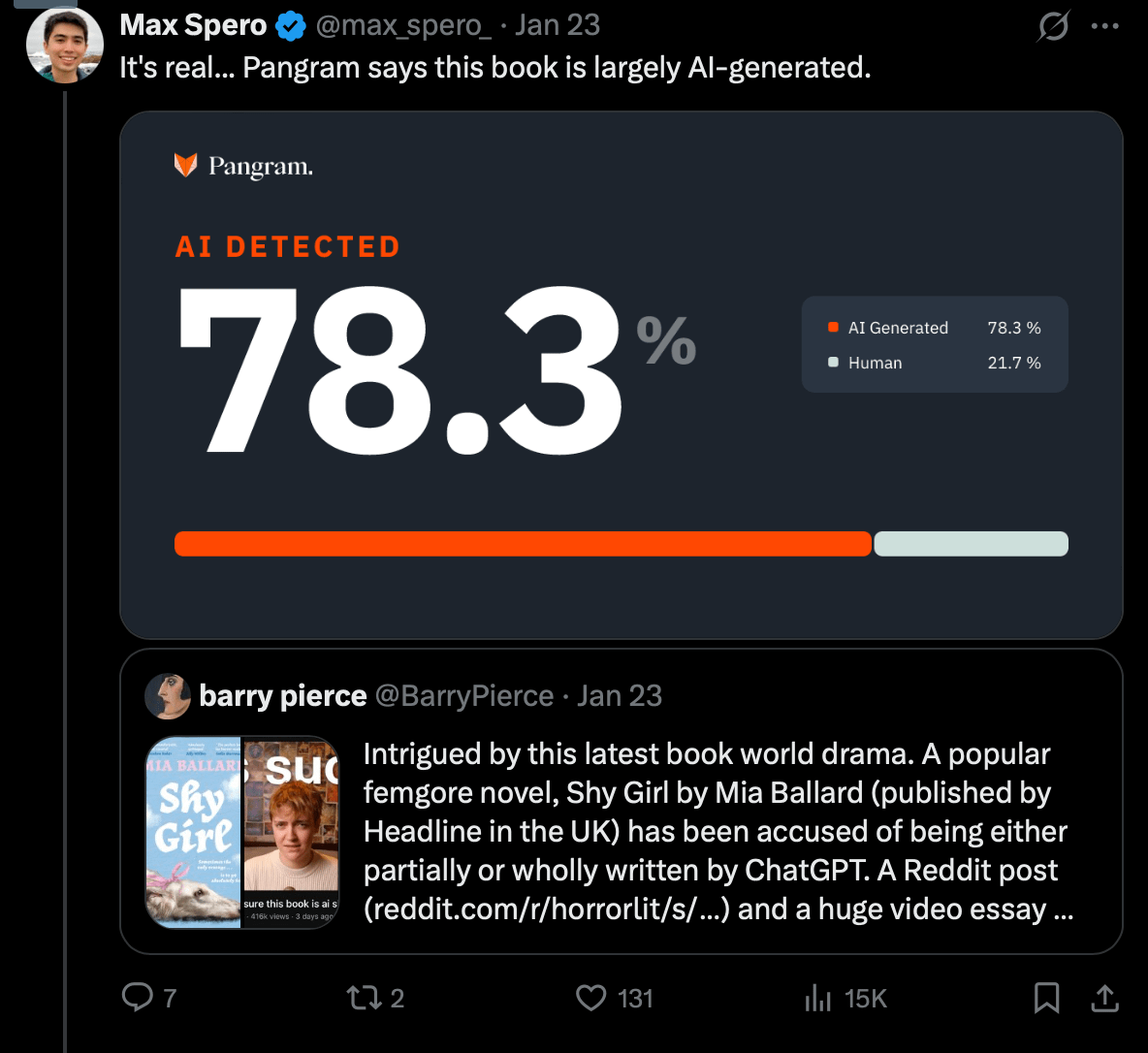
A tweet from Max Spero, founder and CEO of AI detection software Pangram, announcing that his tool had returned a result of 78% AI-generated—a figure that circulated through coverage as though it were a forensic finding.
Months of sustained public pressure on both the author and the publisher.
Then the Times called. Then Hachette acted.
The institutional finding did not precede the verdict. It ratified one already delivered.
As someone who writes with AI tools and knows the heated AI discourse online right now, I have watched this case with more than passing interest.
The Case As Presented
Before evaluating the process, let’s examine the evidence.
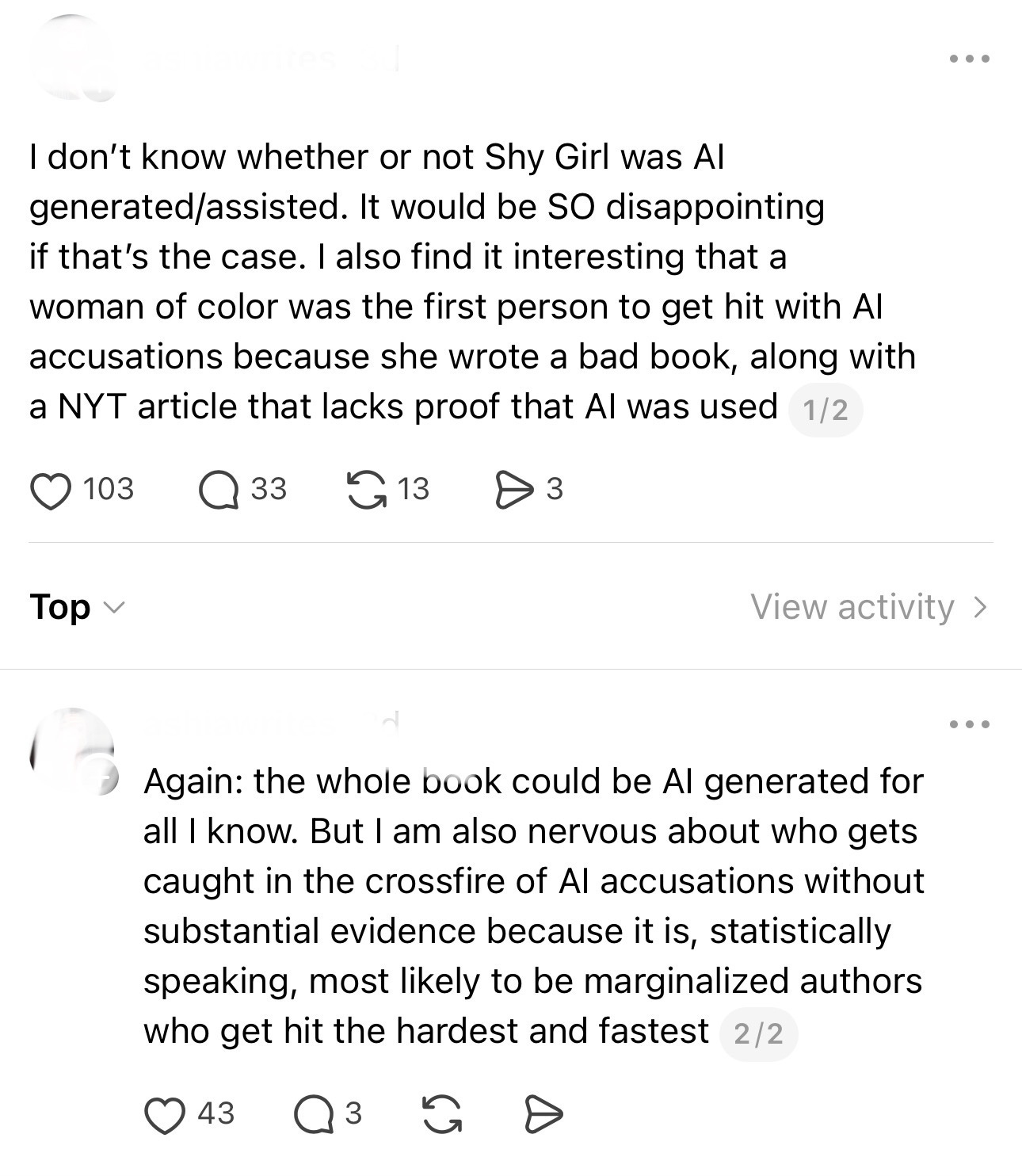
I’m not arguing that Mia Ballard is innocent. I’m arguing that the process that determined her guilt was broken regardless of what she did or didn’t do.
The accusations started with readers, not detectors.
Before any formal investigation took place, early Goodreads reviews said the prose was stylistically flat, had repetitive phrasing, and that the author’s voice lacked consistency. Many accused her work of being AI for these reasons alone. They drew these conclusions based on personal opinions, not from anything definitive.
There were more than 300 comments on a Reddit thread asking if ChatGPT had written Shy Girl. One of the commenters, claiming to be a professional book editor, discussed specific language patterns they saw in large language model output. Readers took the information seriously, despite its anonymity and lack of verification.
The Frankie’s Shelf video was the pivot point.
Over a million people watched nearly three hours of text analysis. It was a long argument based on examples from the text. People who watched it came away convinced.
Then there is the Pangram result.
Max Spero, the company’s founder and CEO, ran the book through his detection software and posted the result publicly: 78% AI-generated. Hachette, in its review, used three separate detection tools: Pangram, Originality AI, and ZeroGPT—all of which reportedly returned AI-positive results.
And there is one more layer of context: before the AI accusations gained momentum, Ballard had already admitted to using a cover image without credit or permission. Ballard found cropped artwork by painter Whyn Lewis on Pinterest and used it without identifying its source.
Despite Hachette's subsequent redesign of the cover, the controversy persisted. While it didn’t prove anything about the manuscript of Shy Girl, it significantly hurt her credibility and gave credence to subsequent accusations, founded or not.
The evidence is real. But suspicion isn’t proof. And the process that treated it as proof is worth examining.
How Online AI Investigations Work — And Why They Get It Wrong
The Shy Girl investigation looked like a community finding the truth. It wasn’t. It was a community confirming what it had already decided.
The difference matters because they look the same from the outside. Both involve gathering evidence, discussing it publicly, and reaching a conclusion. The order of operations is what makes the difference.
In a real investigation, the evidence comes before the verdict. In a mob-driven one, the verdict comes first, and evidence is chosen to back it up. From the start, the Shy Girl timeline followed the second pattern.
Begin with the setting in which the accusations occurred. Ballard had admitted to taking cover art from Pinterest. AI had nothing to do with that argument.
However, it seeded the idea that Ballard was a shortcut author, even before the initial AI accusation surfaced. Once the framework is established, beliefs align.
Confirmation bias is a structural aspect of how online communities handle information once a suspicion reaches a critical level. The question changes from "Is this true?" to "Does this fit?" Those are two questions, but the second is much easier to answer.
Reddit
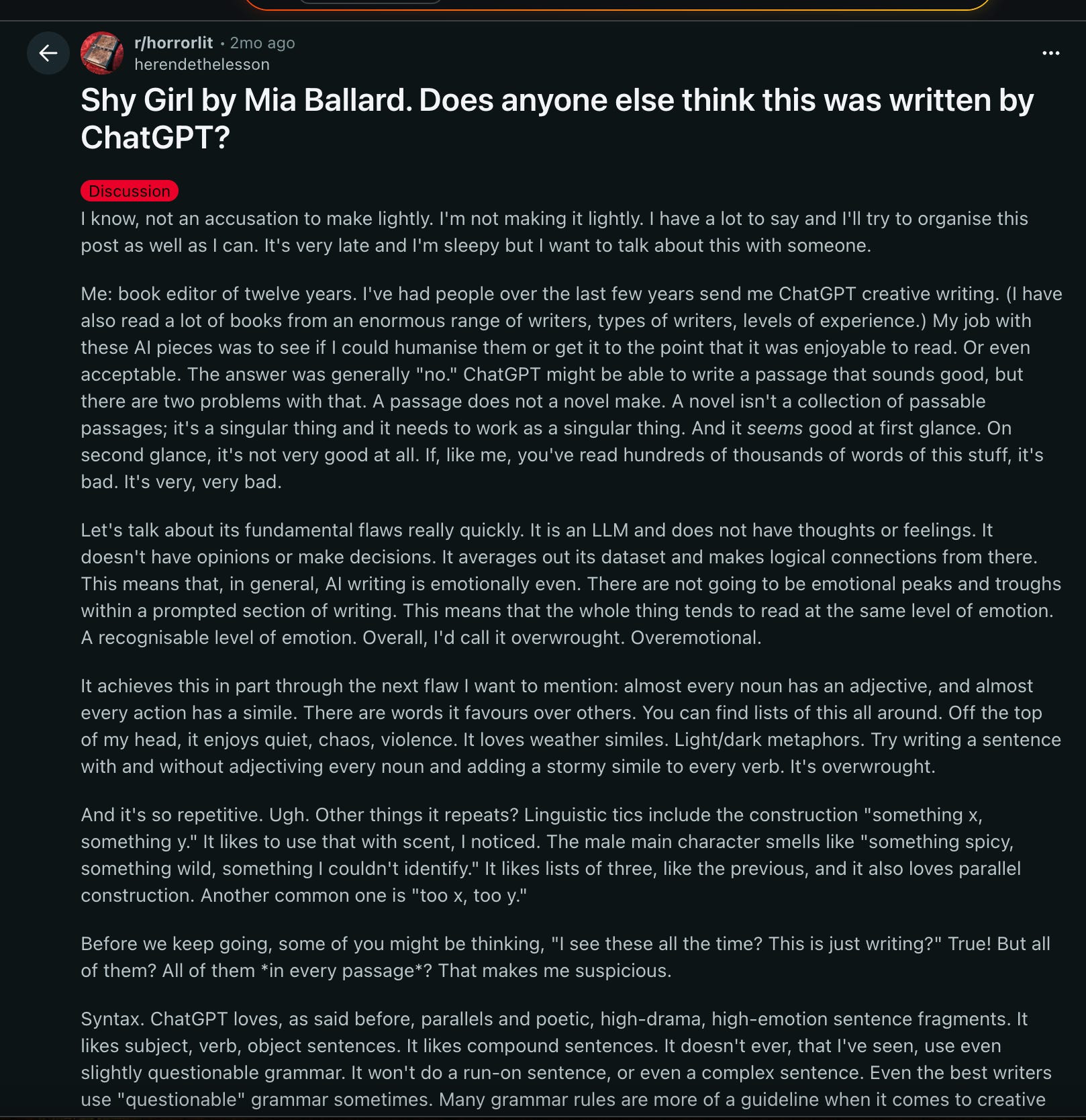
The Reddit thread provides a clear example of these concepts.
A user claiming to be a professional book editor shared a detailed analysis of linguistic patterns associated with large language model output.
“…I find it repulsive that it has been picked up and published by the second largest publishing company, at least in the UK. If it isn’t AI, she’s a terrible writer. Her writing is truly indistinguishable from an LLM.”
The post was anonymous, so there was no way to verify the user’s credentials or methodology. However, this didn’t slow the spread because it confirmed what the community believed they already knew.
YouTube
The Frankie’s Shelf video is more complicated because it was so detailed. But method and confidence are not the same thing, and rigor is not the same thing as detail. The video showed stylistic pattern recognition as if it were a form of forensic analysis. It wasn’t.

Pattern recognition by an engaged reader is a legitimate starting point for an investigation, but it’s not the entire investigation. Over a million people were convinced, not because it was a valid argument, but because it seemed to make sense.
Pangram and AI “Detectors”
Max Spero from Pangram told everyone that his tool had given a 78% AI-generated result. By the time that number circulated, the community had already made up its mind.
The Pangram result didn't add any new information to a fair investigation. It appeared to be scientific validation of an established conclusion. That's a big difference that wasn't addressed.
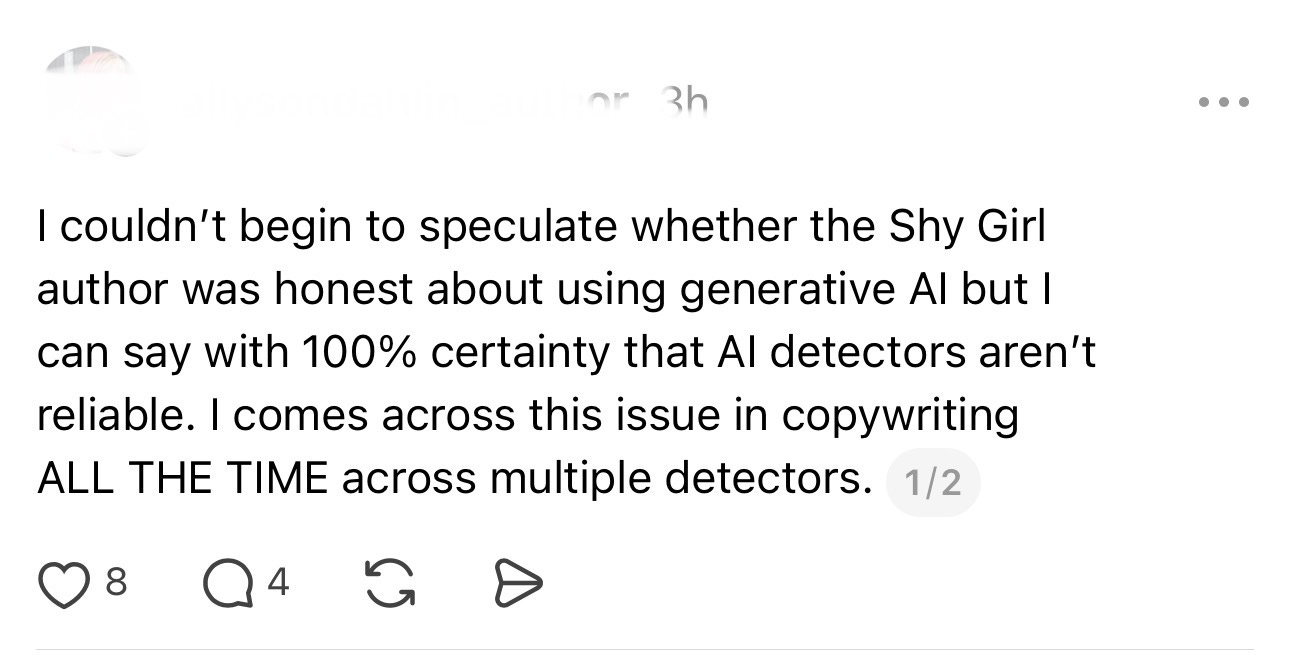
These investigations work like this. Not through malice or stupidity, but because of the way suspicion spreads online. Virality gives evidence its own weight. A million views feels like consensus. A post from a stranger who sounds like they have credentials makes it seem like they are an expert. It feels like forensic science to get a percentage from a detector.
Hachette didn't act because an investigation found the truth. It acted because it couldn’t ignore. Those are different things.
Why AI Detection Tools Like Pangram and ZeroGPT Aren't Forensic Evidence
Hachette says it used three detection tools, Pangram, Originality AI, and ZeroGPT, which all returned AI-positive results. That sounds rigorous. Three independent data points, all pointing the same direction.
Except they aren’t independent. They are all trained to discover text features that are linked to AI output using probabilistic pattern matching. It’s not triangulation when three tools built on the same idea give you the same results. It’s the same flaw repeated three times.
Why does this matter? Because these tools are not forensic instruments.
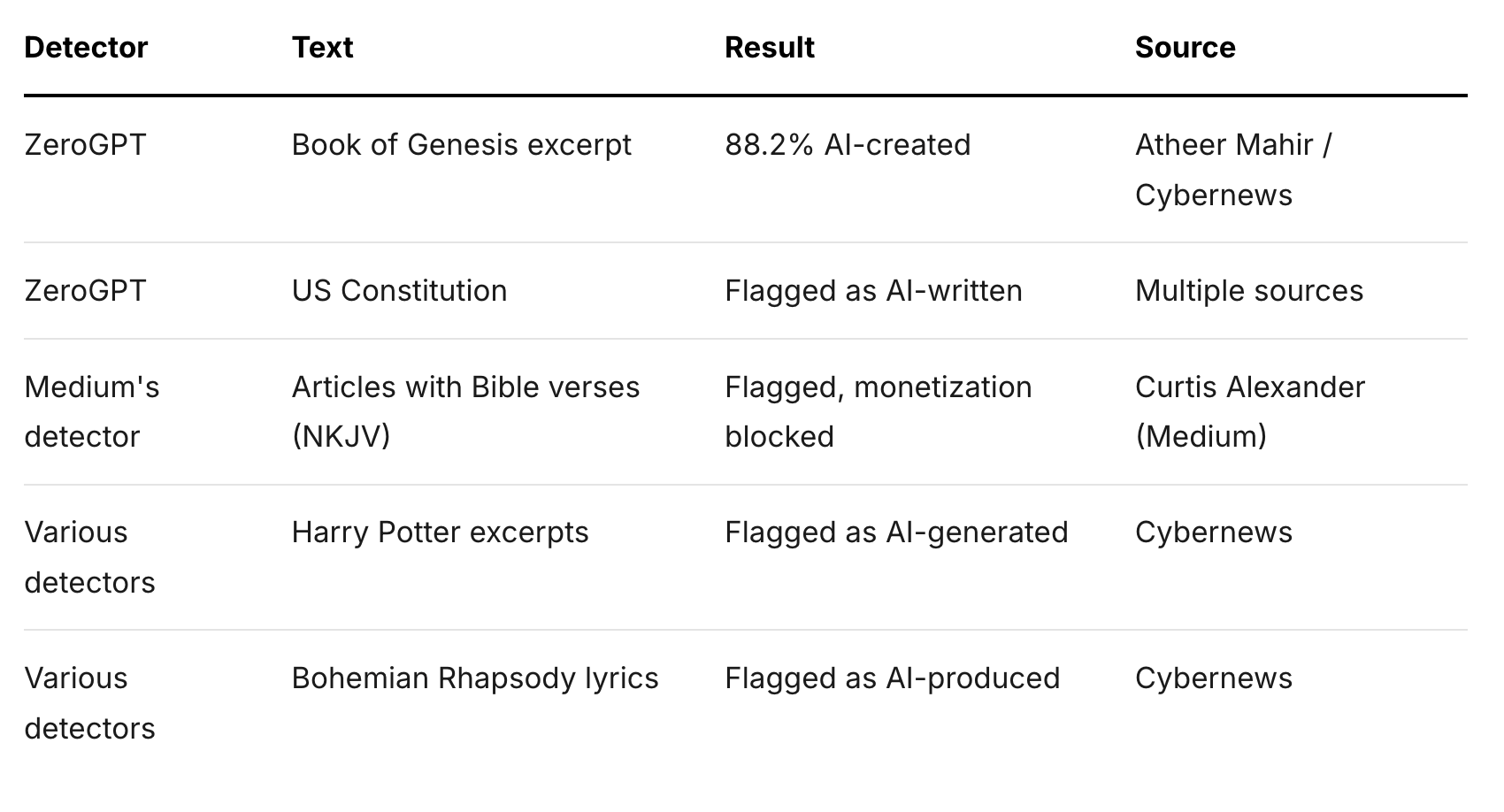
They do not detect AI. They detect patterns common in AI. Those same patterns appear in highly edited prose, formal academic writing, non-native English, and neurodivergent writers whose natural cadence doesn’t match conventional rhythms. These AI “detectors” returned positive results on The King James Bible, a document predating AI by thousands of years.
That’s not a minor calibration issue. It’s a fundamental limitation of what the technology can and cannot do.
A 78% result sounds like a strong finding, but it isn’t.
There is no publicly disclosed false positive rate or independent validation for Pangram’s specific 78% claim. Max Spero did not explain what makes his findings reliable and what separates him from other detectors. He never addressed what the margin of error looks like, or how many human-written books have returned comparable scores.
He merely posted a number in an attempt to promote his business.
That number moved through coverage as a fact. It was a data point. When someone uses a data point to end a career, it makes a significant difference.
There is more to say about this.
The Pangram result, specifically the methodology, the founder’s public positioning, and the financial incentives of a detection company that benefits from appearing authoritative, deserves more scrutiny than it has received. That scrutiny is coming in a follow-up piece.
For now, the question is simpler: How much should a probabilistic pattern matcher be sufficient grounds for a publisher to cancel a contract and destroy a debut author’s career?
Nobody in the mainstream coverage asked that question. They should have.
Hatchette’s Role—The Institution That Should Have Known Better

On March 19, the New York Times contacted Hachette with questions and evidence about Shy Girl. On March 20, Hachette cancelled the contract.
However, there are problems with this timeline.
A thorough and lengthy review producing a career-ending institutional decision in twenty-four hours isn’t a review. It’s a crisis communications response with better branding.
This issue matters because Hachette’s swift, principled-sounding exit has been largely accepted at face value. It shouldn’t be.
Consider the acquisition itself. Hachette picked up a self-published novel that had already generated two separate controversies before the ink on the contract dried. The question of due diligence: did anyone at Hachette actually read this manuscript before acquisition? Or did the social media numbers do all the work?
If the prose was flat and repetitive to readers with no professional stake, what exactly were the editors doing during the acquisition process?
Traditional publishing’s central value proposition has always been editorial rigor. Professionals read, assess, and shape a manuscript before it reaches the public. If that process failed here, then the following crisis is not entirely Mia Ballard’s fault.
Then there is the policy contradiction.
While Hachette requires authors to disclose AI use, it does not, at least publicly, prohibit it. But the cancellation was announced as though the violation was AI use rather than lack of disclosure. Hachette got to perform a principled anti-AI stance it has never actually articulated.
By March 2026, Hachette was holding a contract with an author embroiled in a cover art controversy and public accusations of AI use and attracting the attention of the New York Times.
The AI accusations gave Hachette something the cover art dispute and the general controversy couldn’t: a clean, principled-sounding contractual exit. A statement about protecting original creative expression. A narrative where the publisher is the defender of human authorship rather than the company that acquired a problematic book without adequate vetting and published it anyway.
Did alleged AI use really drive this decision? Or did AI use provide the most convenient available justification for a decision that was already being made for other reasons?
That question has not been asked. It should be.
And then there is Whyn Lewis, the painter whose work Ballard took from Pinterest and used without credit or permission.
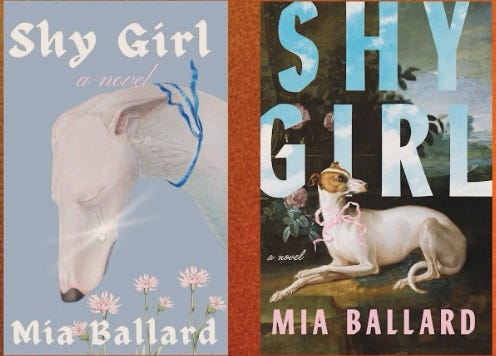
When Hachette acquired Shy Girl, they didn’t credit Lewis or compensate her. They redesigned the cover. Lewis has pursued legal action and correspondence over the infringement, but the current status is not publicly clear.
She is arguably the most straightforwardly wronged person in this entire story. Her work was taken and laundered through a corporate redesign without compensation. The publisher, who has since said in public that they will protect original creative expression, demonstrated something telling before the AI story even came out.
That tells you something about what Hachette's priorities are and when they apply.
Ballard’s Position—Neither Vindicated or Condemned
Here is a scenario the publishing industry has no framework for.
A writer hires a freelance editor to look over her self-published book. That editor runs large parts of the text through an AI tool without the author’s knowledge or permission. In good faith, the author signs a statement that her work is original with her new publisher. The AI-assisted editing is later detected. The author’s contract is cancelled. Her career is destroyed.
If Mia Ballard’s account is accurate, that’s exactly what happened. And current publishing contracts don’t address it. Authors are asked to declare that their work is original and that they have disclosed any AI use.
Nobody in that contractual chain asked whether the author’s independent editor used AI. Nobody asked whether the author would even have the technical knowledge to detect it. The checkbox exists where a policy should be, and the author bears full liability for a third party’s undisclosed actions.
That contractual gap is not a hypothetical problem. If Ballard is being truthful, this is the primary issue. And even if she isn’t, it remains a structural vulnerability that will affect other authors in situations with less ambiguity.
According to Ballard, an acquaintance she hired to edit the self-published version of the book used it without her knowledge. She has declined to elaborate because she is pursuing legal action. That means that her defense can't be argued against right now, which doesn't matter in a court of public opinion but might in a real one.
The editor defense has problems even if true.
It implies either that Ballard knowingly accepted a substantially AI-rewritten manuscript without objection or that she failed to recognize her own work had been drastically altered. Neither is a clean answer.
But here is the question nobody is sitting with: developmental editors substantially reshape prose all the time. A developmental editor can rewrite sentences, restructure chapters, and significantly alter voice, yet nobody considers that a violation of originality. The line between aggressive editing and AI-assisted editing is blurred. The industry is enforcing a standard it hasn’t even defined.
Then there is what this has actually cost her.
Ballard wrote to the New York Times that the controversy has dramatically changed her life. She noted that her mental health was at an all-time low, and that her name had been ruined for something she did not personally do. Whatever your conclusion about her guilt, that statement should be taken seriously.
What if Ballard had taken things further, only to later be exonerated? People have ended their lives over false accusations previously, especially if they suffered consequences such as a loss of reputation, career, or even family.
Trial by algorithm has a human cost. The social media users who “called her out” by sending hateful messages, the Frankie’s Shelf YouTube documentary that convinced over a million, and Max Spero’s 78% AI-positive estimate circulated as a fact—none of them will experience the consequences of being wrong if they are mistaken.
In 2025, an X user posted a criticism of another user’s artwork, claiming it was AI. The post went viral, and the artist received so much harassment that they left social media. In a plot twist, the accuser was proven wrong. Did they face the same level of harassment inflicted on the innocent party? No. For them, life went on.
That is not an argument for her innocence. It is an argument for balance. And that balance has been entirely absent.
Disclosure Is Not a Ban: The AI Policy Distinction Nobody in Publishing Is Making
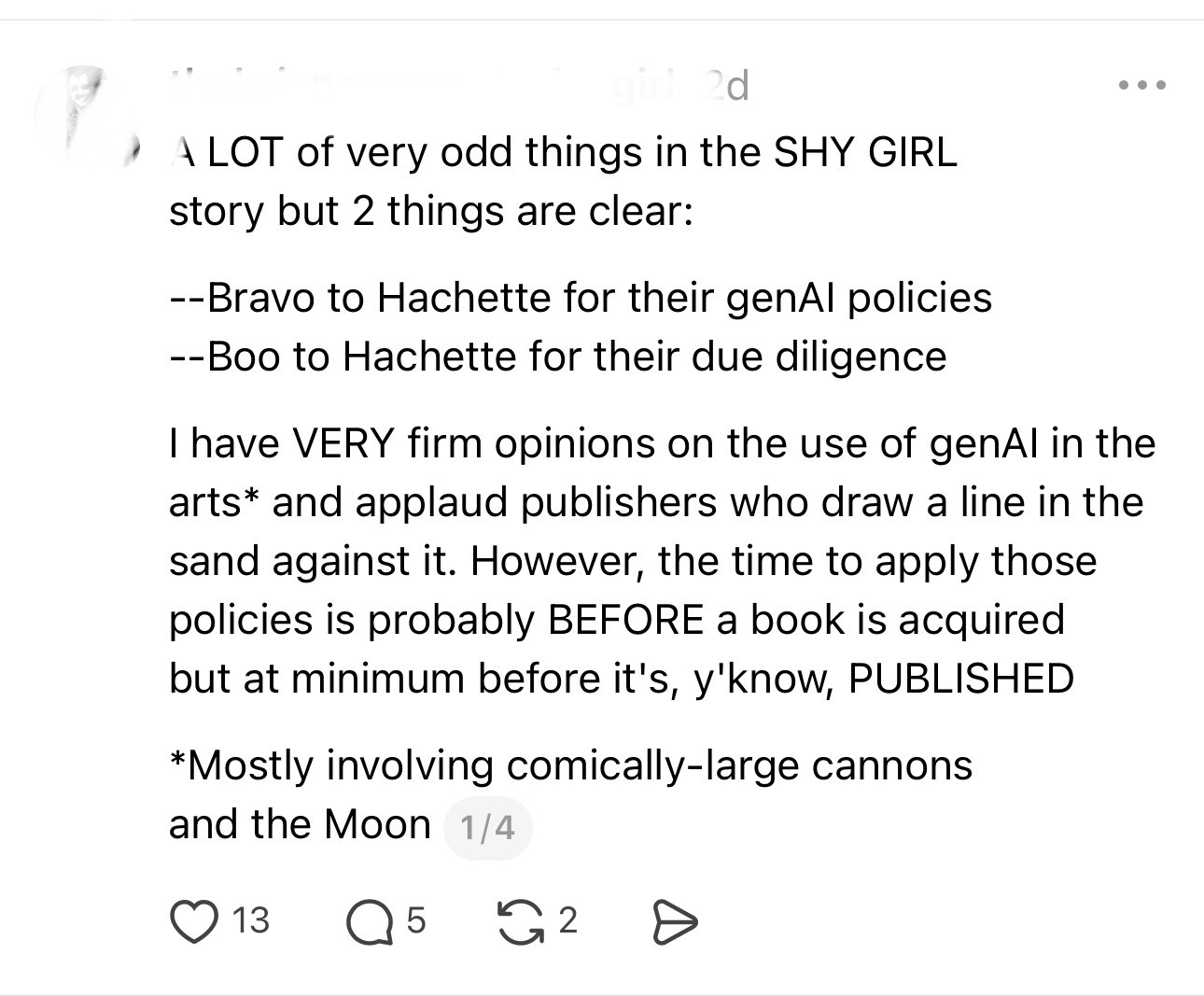
The anti-AI community has framed the Shy Girl cancellation as a victory. A major publisher stood up for human authorship. AI was caught, exposed, and punished. The system worked.
Unfortunately, that’s not what happened.
Hachette requires authors to disclose whether AI was used during the writing process. Hachette has never said it will not publish AI-assisted work. Those are entirely different policies.
If Hachette’s framing is accurate, what was punished here was not AI use. It was undisclosed AI use, which is a much narrower finding than the one publicized. If an author used AI assistance and disclosed it upfront, they would be in compliance with Hachette’s contractual requirements.
Would Hachette have still acquired the book under those circumstances? Would they have negotiated different terms? Nobody knows. The industry hasn’t articulated an actual AI policy. It has performed one, reactively, when the pressure intensified.
The consequences of this apply to every author, regardless of their personal feelings about AI use.
An author who finds AI use ethically repugnant is just as vulnerable as one who embraces it. If a cover artist, a developmental editor, a sensitivity reader, or a proofreader uses AI tools without disclosure, the author absorbs the liability.
Their personal position on AI is irrelevant. Their public statements against AI use are irrelevant.
The contract doesn't ask how you feel about the technology. It asks whether you used it. The question assumes the author has full input at every stage of their manuscript's production. Most authors don't.
When publishing contracts ask: Did you use AI?, they don’t say, “Here is what constitutes acceptable use. Here is what requires disclosure. Here is what happens if a 3rd party uses AI without your knowlege.”
None of that exists.
What exists is a declaration of originality, a vague disclosure requirement, and the implicit understanding that if things go wrong the author bears the consequences regardless of the specifics.
That is not a policy. It is a liability shield for publishers disguised as one.
The writers most at risk in this environment are not the ones using AI recklessly. They are the ones trying to navigate in good faith—disclosing any AI use, considering the line between assistance and generation, and operating transparently in an industry that has not yet defined what that is.
The Shy Girl case has been read as a warning about AI use. It should be read as a warning about the absence of clear standards.
The anti-AI community got what it wanted from this case. It didn’t get what it thinks it got.
The Question the Case Leaves Open

The Shy Girl case will be quoted as a cautionary tale about AI in publishing. An author used AI, got caught, and a major publisher took a stand. Clean narrative. Satisfying ending.
Except that isn’t what happened. Or at least, it isn’t all that happened.
Here’s what did:
A community reached a verdict before any institution investigated.
A publisher acquired a controversial book without adequate vetting and cancelled it about twenty-four hours after a major newspaper called.
An artist had her work stolen, watched it get laundered through a corporate redesign, and became a footnote.
An author, guilty or not, had her career ended by a process designed against her from the beginning.
And a number, 78%, generated by a tool with no disclosed methodology and no published false positive rate, traveled through hundreds of news articles as though it were evidence.
We don’t know if Mia Ballard used AI. We may never know. But we know the process that determined she did was not built to find the truth. It was built to end a news cycle.
That should matter. It largely hasn’t.
Here is what the Shy Girl case actually leaves behind for every writer working right now:
People with financial and ideological interests in AI's conclusions are building the infrastructure to police it in creative work. They are using unverified tools in a world where accusations spread faster than evidence and institutions respond to public pressure rather than the truth.
Even if an author is completely against AI and never uses it, they could still end up in Mia Ballard's situation if the wrong person in their production chain makes a bad choice without disclosure.
A signed declaration will not protect them. Their public statements against AI will not protect them. The community that would have defended them yesterday will turn on them tomorrow, and the publisher holding their contract will have a clean exit waiting.
Those celebrating this outcome as a victory for human authorship should ask themselves what happens when that infrastructure is turned on someone who’s completely innocent? What recourse exists? What standard of evidence applies? Who bears the consequences of being wrong?
The answer, right now, is that nobody has built that part yet. They were too busy building the accusation.