
Publishing's Thoughts on AI (And Why No One Will Say It Out Loud)


The Conversation Publishing Is Having in Public vs. in Private
There are two conversations about AI in publishing. There’s the loud one on social media, and then there’s the real one happening in boardrooms, contract negotiations, and quarterly earnings calls. They barely resemble each other.
On social media, some independent booksellers and small‑press publishers publicly pledge that they will not stock or publish AI‑generated or AI‑assisted books and threaten to drop authors they believe have used such tools.
Meanwhile, the biggest publishers in the world, the ones controlling most of the merchandise sold in those same bookstores, have said very little. No proclamations, prohibitions, or even a clear policy. Just silence.
Any writer making decisions about their career at this time must understand the difference. Reality and noise are not the same. Furthermore, contrary to what the noise suggests, reality is far more complex.
What the Big Five Publishers Have Said

Most book sales in the US flow through five publishers: Penguin Random House, HarperCollins, Simon & Sch
uster, Hachette Book Group, and Macmillan. None of them have released a public, house-wide rule forbidding authors from using AI tools. Only one, Simon & Schuster, responded at all to an open letter from authors requesting AI policies. The response merely stated that the company "takes these concerns seriously."
That’s a holding statement, not a policy.
In late 2024, HarperCollins became the first of the Big Five publishers to reach a licensing agreement permitting the use of its nonfiction backlist for AI training. This agreement was reportedly reached with Microsoft for a fee of $5,000 per title over three years, divided equally between publisher and author on an opt-in basis.
Penguin Random House went the opposite route, adding language to its copyright pages stating that its books could not be used to train AI systems. This move was intended to protect authors’ work from being used for training purposes without permission.
Neither of these agreements prevents authors from using AI tools themselves.
Three of the Big Five, Penguin Random House, Hachette, and Macmillan, have added AI-related clauses into their contracts. The policies state that publishers won’t allow AI training without the author’s consent. Since this language is not yet standard, authors or agents often have to negotiate for it.
The Big Five seem to be concentrating on the issue of training and licensing. Policies regarding authors using AI tools to draft a scene or designing a cover with an AI image generator remain unclear, at least publicly.
There is a reason for this. These publishers internally use AI tools for marketing, cover design, translation, and editing. At the same time, they negotiate millions of dollars in licensing agreements with AI companies. A policy limiting AI use by authors would be hypocritical. They’d run the risk of upsetting their author base on both sides of the AI debate.
What Independent Booksellers and Publishers Are Saying
The loudest opposition to AI in publishing is at the independent level. Some independent booksellers and small presses publicly pledge, often on social media, that they will not stock or publish AI‑generated or AI‑assisted books.
The American Booksellers Association (ABA) describes its members as locally owned businesses that ‘support local schools’ and community life, and positions indie stores as curated, community‑oriented alternatives to chains.
Stocking AI-assisted work may seem incompatible with their brand and reader expectations.
The False Binary: Why 'Generative AI vs. Assistive AI' Misunderstands How Technology Actually Works

“Hey, so... if you’re an author/writer and you brag about how AI is helpful for feedback on writing... It’s an instant block.
Why the Loudest Voices Aren't Always the Most Consequential
However, it is important to note the discrepancy between public declarations and implementations.
A vendor’s preference may say: We will not work with an author who uses AI.
However, some add: If we find out you used AI in any way, we will ban you permanently.
Given that AI detection tools are unreliable and can mislabel human work, any suggestion that bookstores will ‘investigate’ authors’ processes at scale is more of a rhetorical threat than an enforceable policy.
Bookseller leaders have voiced skepticism about AI-generated books; for example, Waterstones CEO James Daunt says his chain would "instinctively shy away" from stocking AI-generated titles unless they were clearly labeled and driven by customer demand.
In mid‑2023, the American Booksellers Association published guidance that was partly written with ChatGPT and urged member stores to ‘play around with ChatGPT’ and begin drafting their AI policies.
Even as author lawsuits over AI training were beginning, the ABA briefly published ChatGPT‑generated guidance encouraging members to explore AI tools, then quietly pulled back from that stance as litigation and author anger escalated.
The ABA’s brief ‘lost summer’ of AI pragmatism, followed by a quiet retreat as lawsuits and author backlash mounted, illustrates how quickly business attitudes can shift around new technology.

The Distributor Layer: Where Policy Has Real Teeth
Book distributors are the hidden bridge between publishers and bookstores. Readers and even authors forget about them. However, these companies’ policies have a real-world impact on working writers, much more than random social media posts.
Most independent bookstores and libraries source inventory through Ingram, who describes itself as maintaining “a digital catalog of millions of books that are made available to thousands of bookstore and library partners around the world.”
IngramSpark's Catalog Integrity Guidelines
IngramSpark’s “Catalog Integrity Guidelines” explicitly list as prohibited:
“Content created using automated means, including but not limited to content generated using artificial intelligence or mass-produced processes.”
The ramifications of this policy are not entirely clear.
Publishing analyst Thad McIlroy reports that his book on AI in publishing was briefly removed from Ingram’s distribution catalog under the Catalog Integrity policy before being reinstated after he challenged the decision.
IngramSpark’s blog posts stress that the Catalog Integrity team conducts “ongoing review of all titles and accounts” and that content violating these guidelines may be removed from distribution. However, they add the authors whose titles are removed can appeal, as McIlroy did.
Industry commentators say Ingram’s rule is primarily aimed at mass-produced "garbage" titles generated by content scrapers or bare-bones AIs rather than at human-authored books that use AI as a background tool.
It’s worth noting that Ingram has a balanced view of AI, publishing many blog posts advising self-published writers of the practical uses of AI, as well as promoting their AI marketing tools.
Amazon KDP: The AI-Generated vs. AI-Assisted Distinction
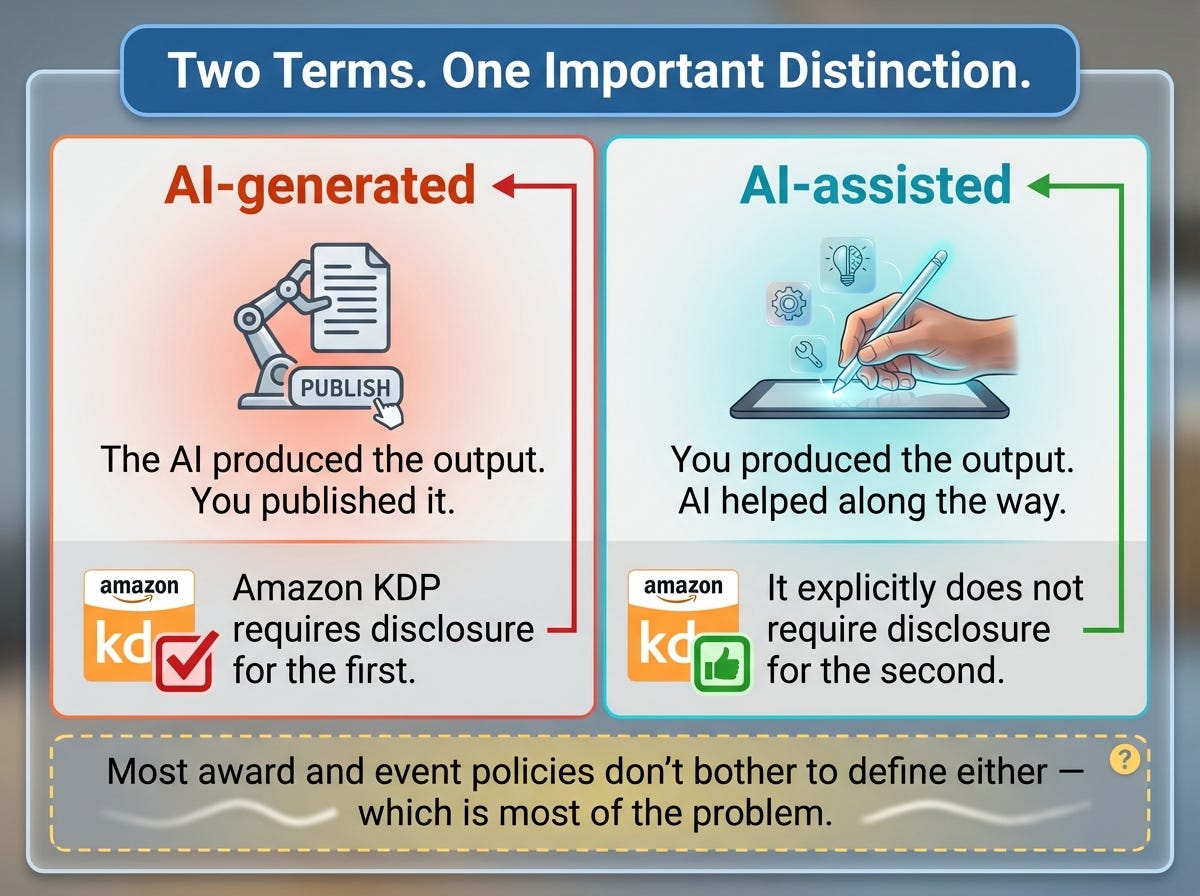
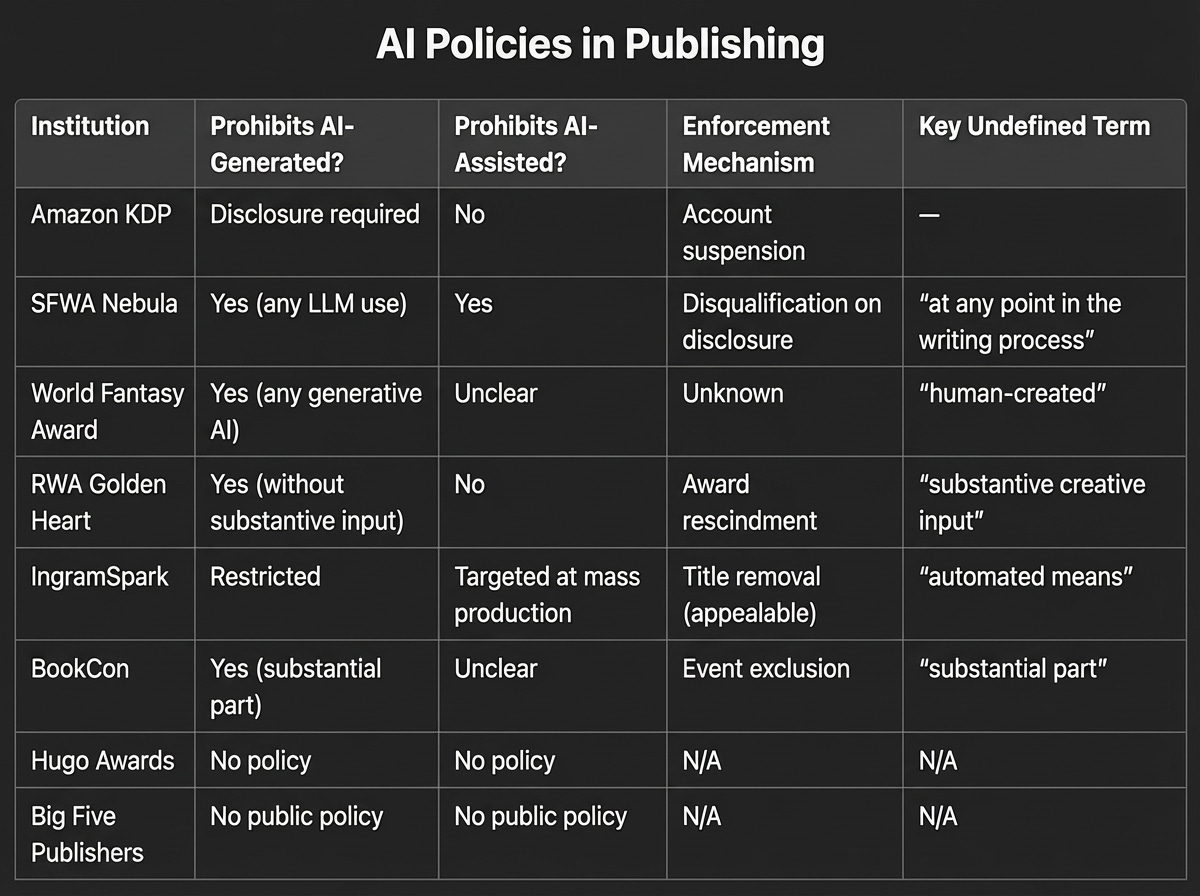
Since late 2023, Amazon’s Kindle Direct Publishing platform has required authors to disclose to Amazon whether a book contains AI‑generated text, images, or translations, while exempting merely ‘AI‑assisted’ work from disclosure.
The Authors Guild reported that the change came after months of discussion with Amazon about “AI-generated books flooding the platform” and notes that the disclosure requirement is to Amazon, not necessarily to readers.
Recent guidance to authors explains that KDP separates “AI-generated content” (text, images, or translations made by an AI tool, even if later changed) from “AI-assisted content” (help with ideas, grammar, or outlines), and only the first type needs to be disclosed. These guides also note that the policy has been in effect since late 2023 and has been enforced more strictly in 2025–2026.
In 2024, as part of a quality‑control initiative, Barnes & Noble (B&N) began limiting the number of print titles it offers in its online store and delisted thousands of self‑published titles without warning across all formats, especially in categories such as erotica, public‑domain reprints, and summary books.
Distributor Draft2Digital estimated that roughly 10,000 erotica titles would be removed from B&N.com under the new content rules, and later communications from distributors indicated that summary books were also being removed or blocked at multiple retailers.
B&N and its partners say these actions are meant to uphold content rules and get rid of low-quality or rule-breaking material; there’s no sign that B&N was specifically going after writers for using AI tools in their writing or for making one AI-assisted cover image.
Award and Event Policies: A Spectrum from Clear to Nonexistent
If you’ve spent any time in writing communities online, you’ve heard the confident declarations: “AI is banned everywhere.” “You’ll never get published if you use AI.” “Every major award has a zero-tolerance policy.” The reality, when you go read the actual policies, is considerably messier.
Some policies are clear. Most are vague. Many don’t exist at all. They all have the same basic issue: they were written to signal values, not enforce them. Understanding the difference between those two things is essential for any writer.
The World Fantasy Award: A Clear Line, Unenforced
The World Fantasy Award’s 2025 submission guidelines state:
Any work made with any generative AI will not be deemed human-created and is thus not eligible for consideration.
This statement is as straightforward as it gets. It is categorical—any generative AI involvement, regardless of degree, disqualifies the work. It establishes a clear boundary.
The problem the World Fantasy Awards shares with almost every other policy is that the language stops at prohibition and offers nothing on enforcement.
How will the judges determine whether a work used generative AI?
Who bears the burden of proof?
What process follows a complaint?
The policy doesn’t say. A clean line that no one knows how to verify is cleaner in language than in practice.
The Nebula Awards: How a Policy Changed in a Single News Cycle
The Nebula Awards’ AI policy had a public evolution that reveals exactly how institutions are struggling with this question in real time.
SFWA’s rules as of late 2025 state, “Works that are written, either wholly or partially, by generative large language model (LLM) tools are not eligible.” with the accompanying statement reading, "SFWA does not support the use of LLM generative models in the production of creative work."
What’s notable is what the policy was before pressure changed it.
SFWA initially proposed a graduated approach: works using LLMs (large language models) would disclose this, and disclosure would be shared with voters as neutral information rather than as an automatic disqualifier.
Within hours, the backlash was severe enough that SFWA moved to a full ban.
The arc from “disclosure for voters to decide” to “any LLM use disqualifies” occurred within a single news cycle. That’s not a careful policy decision; that’s social pressure.
The RWA Golden Heart: The Best Attempt at a Nuanced Standard
The Romance Writers of America’s award policy prohibits “any narrative, dialogue, or descriptive text within a romance novel that is created by an AI system without substantive creative input from a human author,” while permitting AI assistive tools such as grammar checks and copyediting.
It requires human authors to create “the foundational premise, characters, plot points, themes, and settings” and states that “AI cannot drive major story aspects.”
This approach is more detailed, though it leaves ”substantive creative input” undefined.
What’s substantive?
Is it substantive creative input if a writer prompts an AI to draft a scene outline and then rewrites every sentence?
If a writer accepts an AI’s suggested dialogue and heavily edits it, has AI “driven” a story aspect?
The policy doesn’t say.
The Hugo Awards: No Policy At All
The WSFS Constitution, which governs the Hugo Awards, contains no AI-specific rules. None. There is no standing policy on AI-generated or AI-assisted work, and no Hugo Award-specific AI eligibility rules were published for the 2025 Seattle Worldcon.
The only AI-adjacent statement from the 2025 Worldcon was an ad hoc clarification issued after a controversy—not about submissions, but about administrators using AI tools in running the awards process.
The statement, "No LLMs or generative AI have been used in the Hugo Awards process at any stage," served as crisis communication, not a policy. The Hugos, one of the most prestigious awards in speculative fiction, currently have no formal position on AI in submitted work.

The Enforcement Problem: Why "Any AI" Bans Can't Be Enforced
AI Detection Tools Don't Work Reliably
Policies prohibiting AI have a major problem: there is currently no reliable way to detect AI in written text.
AI detection tools exist, but none of them are reliable. Significant false positive rates—that is, human-written content that is mistakenly identified as AI-generated—have been reported by independent studies.
Grammarly’s help page warns that “the percentage result should not be used as an objective source of truth, as AI detection of any kind can be prone to errors,” which is as close as a vendor will get to acknowledging unreliability in plain language
In Copyleaks’ February 2026 blog post titled “Is Grammarly Considered AI-Generated Content?”, they used Grammarly’s generative “Improve it” feature to correct 500 human-written files. When they ran the results through an AI detector, “31.6% returned as AI content and 68.3% as human."
They cited another analysis where a different AI detector misclassified 20% of spell-and-grammar-checked text as AI.
Some platforms treat detector flags as grounds for rejection or termination, despite documented false positives on polished, human‑written text, including text lightly edited with non‑generative tools.
This creates a real issue for rules banning AI-assisted work and trying to enforce that ban with detection tools: AI detectors make enough mistakes to pose a risk to honest human writers. And most policies do not have appeals processes that account for false positives.
Microsoft Editor and Copilot as AI
Here’s a deeper problem: Microsoft Word’s Editor feature—included in standard Microsoft 365 subscriptions used by hundreds of millions of people—is AI-powered…and has been for years.
Microsoft’s Copilot, now integrated into Word, can rewrite selected text, suggest alternative phrasings, and restructure paragraphs using machine learning and natural language processing. Accepting a Word Editor suggestion is, technically, inserting AI input in your writing.
How current literary policies intersect (or don’t)
So, when does accepting a Copilot suggestion transform from "AI-assisted" to something that the invoked policy forbids?
None of the policies discussed here answer that question.
The RWA policy specifies exceptions for “grammar checks” and “copy editing” tools. The SFWA policy bans any LLM use. Neither addresses Microsoft Word’s Copilot, which is embedded in a tool most writers already use.
KDP’s generated/assisted framework is one of the only widely used, operationalized standards, and no major award policy has directly adopted it.
What a Workable Policy Looks Like
It’s worth noting that one academic publisher, SAGE Publications, has arrived at a similar framework for journal submissions.
SAGE’s current stance is that generative AI can be used in writing, but authors must stay fully responsible for accuracy and be transparent when AI is used beyond routine language polishing.
Core distinction they make
Assistive AI (no disclosure needed): Tools for spelling, grammar, formatting, or minor language refinement (e.g., spellcheckers, grammar checkers, simple style helpers) are allowed and generally do not need to be disclosed.
Generative AI (disclosure required): Tools like ChatGPT/LLMs to generate substantive content, text passages, summaries, images, or reference lists must be explicitly disclosed in the manuscript (often in Methods or Acknowledgments) and checked by the human author.
Author responsibility and limits
AI tools cannot be listed as authors and cannot take responsibility or accountability for the work; humans remain fully responsible for the integrity, accuracy, and originality of all content.
SAGE emphasizes that current language models are not fully objective or factual and that authors using them “must make every effort to ensure that the output is factually correct, and the references provided reflect the claims made.”
Many SAGE journals add extra constraints (for example, some do not allow AI to generate original text or ideas at all), so authors must always check the specific journal’s AI or authorship guidelines.
This is what a functional policy looks like: it defines its terms, distinguishes between generation and assistance, and assigns responsibility.
What This Means for Working Writers: A Practical Guide
Given the landscape above, here is how to navigate it without catastrophizing or dismissing the real distinctions.
Read the actual policy, not someone’s interpretation of it.
“AI is banned everywhere” is not accurate. Some awards have total bans on generative LLM use in written work. Most major publishers have no clear policy. KDP permits AI-assisted work and only requires disclosure of AI-generated content. Before you make any decision, read the source document.
Know the difference between generated and assisted.
Grammar checks, brainstorming, autocomplete suggestions, outline assistance, and editorial feedback are AI-assisted. If you prompt an AI to write your chapter and publish what it produces, it is considered AI-generated.
Most policies, where they exist, target purely AI-generated content, not Grammarly suggestions. But most don’t clarify this. In this current landscape, your best protection is transparency.
Understand that “any generative AI” policies are unenforceable as written.
In practice, SFWA's ban on any LLM use at any point in the writing process is unenforceable. No detection tool can reliably establish whether an LLM was consulted during a creative process. What the policy actually does is establish a standard of self-certification: by submitting, authors affirm they meet the policy standards.
For events and conferences, focus on what is actually prohibited.
BookCon specifically names products "made available for purchase" at the event in their policy. It does not prohibit AI-using authors from participating. If you register for an event, please review the AI policy, if it exists.
False positives are a real risk. Document your process.
If you use AI tools in any capacity—including grammar checkers with generative features—you know about false positive detection flagging. Keeping drafts and version histories, and being able to articulate what role AI played in your work, gives you something to stand on if you're challenged.
The lack of a policy does not indicate approval.
When an AI policy is absent, like at the Hugo Awards, it means the question is unresolved, not that the answer is yes. If there’s no stated AI policy where you’re submitting, you are in undefined territory.
The policies that matter to your sales are clearer than the ones that matter to your awards.
If your goal is to self-publish, the KDP (Kindle Direct Publishing) and IngramSpark’s platform-level policies have clear guidelines. Award and event policies affect your career less, and most of them currently lack any practical enforcement policies.
The Bottom Line
The current AI policy landscape in publishing is, at best, inconsistent. A lot have vague policies with no enforcement mechanisms. Most major publishers have no public-facing policy on author AI use at all.
Existing policies were mostly written under social pressure, and they fail to address the specific challenges posed by the use of creative AI. Detectors are unreliable. And only one major platform clearly distinguishes between “AI-assisted” and "AI-generated."
The landscape is (albeit slowly) evolving. Eventually, institutions will arrive at better definitions.
In the meantime, the writer who reads the actual documents, understands the real distinctions, and makes conscious and documented choices about their process is substantially better positioned than the one who is either panicking at the most restrictive social media framing or ignoring the policies that do have real teeth.
Know what you’re doing. Know why you’re doing it. Know what the actual rules say. The rest is noise.
Sources
I gathered information for this article from the following sources, which we recommend for further reading:
AI contracts and positions at the Big Five publishers
Publishers Lunch, “Some Publishers Begin to Add AI Language to Contracts,” May 19, 2024, covers new AI‑related contract language at Penguin Random House, Hachette, and Macmillan.
https://lunch.publishersmarketplace.com/2024/05/some-publishers-begin-to-add-ai-language-to-contracts/[lunch.publishersmarketplace]InfoDocket summary of the HarperCollins/Microsoft licensing agreement, “Microsoft Offers Authors $5000 to Train AI On Their Books,” February 2025, with links to original reporting on the deal’s terms.
https://www.infodocket.com/2025/02/09/report-microsoft-offers-authors-5000-to-train-ai-on-their-books/[infodocket]Transparency Coalition analysis, “HarperCollins, Microsoft AI deal sets first public price for training data,” November 25, 2024, discussing the implications of the HarperCollins licensing agreement.
https://www.transparencycoalition.ai/news/harpercollins-ai-deal-with-microsoft-sets-first-public-price-for-training-data[transparencycoalition]NPR, “Authors petition publishers to curtail their use of AI,” June 28, 2025, covers the “Against AI” open letter and the Big Five publishers’ public responses.
https://www.npr.org/2025/06/28/nx-s1-5449166/authors-publishers-ai-letter[npr]
Retail platform and distributor policies
IngramSpark Catalog Integrity Guidelines, which outline Ingram’s policy on “content created using automated means, including but not limited to content generated using artificial intelligence or mass‑produced processes.”
https://www.ingramspark.com/blog/ingramsparks-catalog-integrity-announcement[ingramspark]Jane Friedman, “How AI-Generated Books Could Hurt Self-Publishing Authors,” updated in 2025, provides a clear overview of AI‑generated books, distributors’ responses, and the risks for self‑publishers.
https://www.janefriedman.com/how-ai-generated-books-could-hurt-self-publishing-authors/[bernoff]The Digital Reader, “IngramSpark Announces New Quality Standards for Its POD Service,” February 24, 2020, discusses Ingram’s catalog integrity efforts and how filters are used to keep out low‑quality or automated content.
https://the-digital-reader.com/ingramspark-announces-new-quality-standards-for-its-pod-service/[the-digital-reader]Thad McIlroy, “Ingram Targets the AI in My Book About AI,” July 26, 2024, describes an example of Ingram’s filters mistakenly flagging a book about AI as AI‑generated.
https://www.linkedin.com/pulse/ingram-targets-ai-my-book-thad-mcilroy-mwkic[linkedin]
Independent booksellers and the ABA
American Booksellers Association, “5 Steps for AI and Your Store,” May 23, 2023, shows the ABA’s early, pragmatic guidance on experimenting with AI tools and drafting store policies.
https://www.bookweb.org/news/5-steps-ai-and-your-store-1629561[bookweb]The New Publishing Standard, “The Untapped AI Revolution in Bricks & Mortar Bookstores (and the ABA’s AI Juggling Act),” November 16, 2025, examines the ABA’s initial use of ChatGPT‑generated guidance and its later shift in tone.
https://thenewpublishingstandard.com/2025/11/17/ai-independent-bookshop-opportunity/[thenewpublishingstandard]
The Authors Guild
Authors Guild AI advocacy and information hub, including policy updates and actions on AI and training data.
https://authorsguild.org/advocacy/artificial-intelligence/[authorsguild]Authors Guild, “Anthropic AI Class Certification: Important Information for Authors,” November 10, 2025, explains the Bartz v. Anthropic litigation and what it means for authors.
https://authorsguild.org/news/anthropic-ai-class-action-important-information-for-authors/[authorsguild]Authors Guild annual reports (2023–2024) summarize the Guild’s AI advocacy and lobbying efforts; see particularly the sections on AI and copyright in the 2024 report.
https://authorsguild.org/news/2024-annual-report/[authorsguild]
Copyright and the legal environment
U.S. Copyright Office, “Copyright Registration Guidance: Works Containing AI-Generated Material” (policy statement, March 2023) and “Artificial Intelligence and Copyright: Part II – Copyrightability,” January 2025, set out the Office’s position on AI‑assisted and AI‑generated works.
Registration guidance: https://www.copyright.gov/ai/ai_policy_guidance.html
Report Part II: https://www.copyright.gov/policy/artificial-intelligence/part-ii.html[chicagobooth]
If you’d like, I can now match each bullet here to your internal endnote numbers so you can just paste them into your manuscript in order.